
Authored by Ashitha Abdul Ashraf, Senior Consultant Physiotherapist – Incharge | Medically Reviewed by Dilshana Thasni T, Senior Consultant Physiotherapist | Last Reviewed: June 2026

Degenerative disc disease is one of the most misunderstood diagnoses in spine medicine. Patients hear the word degenerative and assume their spine is deteriorating beyond repair. They hear the word disease and assume something is seriously wrong. Neither of these assumptions is accurate.
Degenerative disc disease is not a disease in the traditional sense. It is a description of age-related changes in the spinal discs that occur in virtually everyone over time. Most people with these changes on an MRI have no pain at all. Many who do have pain recover fully with conservative treatment and go on to live normal, active lives without surgery.
This guide explains what degenerative disc disease actually is, why it causes pain in some people and not others, and how to manage it effectively without surgical intervention.
What Degenerative Disc Disease Actually Is
The intervertebral discs — the shock-absorbing cushions between each pair of vertebrae — are composed of a tough outer ring (the annulus fibrosus) and a gel-like inner core (the nucleus pulposus). In youth, the discs are well-hydrated, resilient, and effective at distributing load across the spine.
With age, the discs lose water content. The nucleus becomes less gel-like and more fibrous. The disc height reduces. The annulus may develop small tears. These are the changes collectively referred to as degenerative disc disease.
On MRI, these changes appear as:
- Reduced disc signal intensity — the disc appears darker than a healthy disc, reflecting its reduced water content
- Loss of disc height — the space between vertebrae is narrower than normal
- Annular tears — small tears in the outer ring of the disc
- Endplate changes — reactive changes in the vertebral bodies adjacent to the degenerated disc
These findings are extremely common. MRI studies of asymptomatic people — people with no back pain — show degenerative disc changes in approximately 37% of people in their 20s, 80% of people in their 50s, and nearly all people over 70. The finding is part of normal ageing. It is not inherently pathological.
Why Does It Cause Pain in Some People and Not Others?
This is the central question and the one most patients never get a clear answer to.
Degenerative disc disease causes pain through several mechanisms, but the presence of degeneration alone does not determine whether pain occurs. Other factors matter equally or more.
Disc height loss and instability. As a disc loses height, the motion segment — the functional unit of two vertebrae and the disc between them — becomes less stable. Excessive movement at the degenerated level can irritate the disc, the facet joints, and surrounding ligaments. This instability-driven pain is position-dependent and activity-dependent.
Annular tears and chemical irritation. Tears in the annulus expose the nerve endings within the outer disc to the nucleus pulposus — which contains inflammatory chemicals that irritate nerve tissue. This is one mechanism of discogenic pain — pain generated from within the disc itself.
Nerve compression. If disc height loss is significant enough, the neural foramen — the opening through which nerve roots exit the spine — narrows. This can compress nerve roots, producing radiculopathy. If disc material herniates through an annular tear, it can compress nerve roots directly.
Central sensitisation. In patients with chronic pain, the nervous system becomes sensitised — amplifying pain signals from structures that might otherwise not generate significant pain. This is why two people with identical MRI findings can have dramatically different pain experiences.
Psychological and social factors. Fear of movement, catastrophising about the diagnosis, occupational distress, and depression all amplify pain in chronic degenerative disc disease. The biopsychosocial model of pain explains why addressing these factors is a component of comprehensive treatment.
The Diagnosis Problem
Degenerative disc disease is over-diagnosed as a cause of pain. Because MRI findings are so common, there is a strong tendency to attribute pain to whatever is found on the scan — even when the clinical picture does not support it.
A 45-year-old with lower back pain gets an MRI. The MRI shows multi-level disc degeneration. The report says degenerative disc disease. The patient is told this is the cause of their pain.
But was the degeneration causing the pain? Or was it incidental — present but not clinically relevant — while the actual pain was coming from a muscle strain, a facet joint, or the sacroiliac joint?
This distinction matters because the treatment is different. Treating the wrong structure produces poor results and unnecessary procedures.
A proper diagnosis requires correlating the imaging findings with the clinical examination. Which level of degeneration, if any, reproduces the patient’s symptoms on examination? Is there neurological involvement? Are the symptoms consistent with discogenic pain or with a different pain source?
Physiotherapy assessment addresses these questions. An MRI report alone does not.
Living Well With Degenerative Disc Disease: The Evidence
The evidence on long-term outcomes for degenerative disc disease is more encouraging than the diagnosis sounds.
Multiple long-term studies show that most patients with symptomatic degenerative disc disease improve significantly over time with conservative management. A study published in Spine following patients with chronic discogenic low back pain found that the majority reported significant improvement in pain and function at 10-year follow-up without surgical intervention.
Surgery for degenerative disc disease — typically spinal fusion — has a mixed evidence base. Multiple randomised controlled trials comparing spinal fusion to intensive conservative rehabilitation for degenerative disc disease have found no significant difference in long-term outcomes between the two groups. Fusion surgery for degenerative disc disease is one of the most debated procedures in spine surgery, with many experts concluding that it is overperformed.
The implication for patients is clear. For most presentations of degenerative disc disease, a comprehensive conservative management program is not just an alternative to surgery — it is the treatment with the best evidence.
Non-Surgical Treatment for Degenerative Disc Disease
Physiotherapy and Spinal Stabilisation Exercise
The cornerstone of conservative degenerative disc disease management.
The rationale is straightforward. Degenerative discs are less able to stabilise the motion segment. The muscles surrounding the spine — particularly the deep stabilisers — must compensate for this reduced mechanical stability. When these muscles are weak or inhibited, the degenerated disc bears more load and generates more pain. Strengthening the stabilising musculature reduces disc load, reduces pain, and improves function.
Motor control exercise. Targeting the multifidus and transverse abdominis — the deep segmental stabilisers that provide dynamic support at each disc level. These muscles are consistently inhibited in patients with chronic discogenic pain. Reactivating and strengthening them is a primary treatment target.
Progressive loading. Gradually increasing spinal loading through functional movements — squats, deadlifts at appropriate loads, carrying — builds the muscular and connective tissue resilience that supports the degenerated disc long-term.
Aerobic conditioning. Regular aerobic exercise reduces central sensitisation, maintains disc hydration through normal movement, and provides significant pain relief through endorphin release. For most degenerative disc disease patients, walking, swimming, and cycling are appropriate and beneficial.
Spinal Decompression Therapy
For degenerative disc disease causing discogenic pain or nerve root compression from reduced foraminal height, spinal decompression therapy is one of the most targeted conservative treatments available.
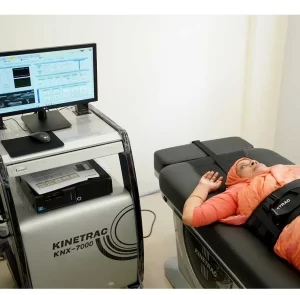
The KNX-7000 system creates negative intradiscal pressure — reducing the load on the degenerated disc, drawing water and nutrients back into the dehydrated disc tissue, and reducing nerve compression from foraminal narrowing.
For patients with chronic discogenic pain — particularly pain from disc height loss and associated nerve root irritation — spinal decompression often achieves improvement that exercise and manual therapy alone cannot produce. A typical course is 15 to 20 sessions.
Spinal decompression therapy is available at all Maana Health clinics across Kerala.
Manual Therapy
Joint mobilisation of the lumbar spine reduces pain, improves mobility, and addresses the facet joint stiffness that commonly accompanies disc degeneration. Manual therapy works best as part of a comprehensive program rather than as a standalone treatment.
Soft tissue release targeting the paraspinal muscles — which chronically tighten in response to discogenic pain — reduces muscle guarding and improves movement quality.
Pain Management
Chronic discogenic pain often requires a multimodal pain management approach alongside physiotherapy.
TENS therapy provides non-pharmacological pain relief, reducing the need for ongoing medication. Therapeutic ultrasound reduces local disc level inflammation. Heat therapy reduces muscle spasm.
For patients with significant pain levels that are limiting rehabilitation, short-term medication management in coordination with a physician provides enough pain control to allow the physiotherapy program to proceed.
Lifestyle Modification
Weight management. Excess body weight increases spinal disc loading with every step. For overweight patients with degenerative disc disease, weight reduction is one of the highest-impact interventions available. Even a 10% reduction in body weight produces measurable reduction in spinal load.
Smoking cessation. Smoking impairs disc nutrition — the discs receive nutrients through diffusion from surrounding tissue, a process that is significantly reduced by the vascular effects of smoking. Smokers have higher rates of disc degeneration and worse surgical outcomes. Smoking cessation is part of degenerative disc disease management.
Ergonomic modification. For desk workers — a large proportion of Kerala’s degenerative disc disease patients — workstation setup directly affects disc loading during the working day. Screen height, lumbar support, sitting duration, and movement breaks all matter.
Sleep position. Sleeping in a position that maintains neutral lumbar spine alignment reduces overnight disc loading. A firm mattress with appropriate pillow support for the spine is recommended. Stomach sleeping is the worst position for degenerative lumbar discs.
Managing Flare-Ups
Degenerative disc disease is a chronic condition. Most patients experience periods of increased pain — flare-ups — triggered by activity, posture, stress, or sometimes no identifiable cause.
Managing flare-ups effectively reduces their duration and prevents the deconditioning and fear-avoidance behaviour that drives chronic pain amplification.
During a flare:
- Reduce, but do not eliminate, activity
- Apply heat to the affected area — heat reduces muscle spasm and is more effective than ice for chronic disc pain
- Continue gentle movement — complete rest prolongs flare-ups
- TENS for pain relief
- Short-term NSAID use if not contraindicated, for no more than 5 to 7 days
- Gentle spinal mobilisation exercises in comfortable ranges
After a flare settles:
- Resume the full exercise program gradually over one to two weeks
- Identify and address the trigger if possible — a new chair, a period of reduced activity, increased stress
- Do not reduce long-term exercise commitment based on a flare — consistent exercise reduces the frequency and severity of future flare-ups
When Surgery Becomes a Consideration
Surgery for degenerative disc disease — most commonly spinal fusion at the degenerated level — is a major intervention with significant risks and a mixed evidence base. It should not be the first, second, or even third treatment considered for degenerative disc disease.
Surgical consideration is appropriate when:
- A genuine 12-week structured physiotherapy program, including spinal decompression where appropriate, has been completed without adequate improvement
- Neurological deficit is progressive — worsening weakness or sensory loss
- Quality of life is severely impaired despite all conservative measures
- Imaging and clinical examination correlate precisely — the level of degeneration matches the clinical symptoms exactly
Even then, the decision for spinal fusion should be made carefully. Fusion eliminates movement at the fused level, increases stress on adjacent levels, and has a significant complication rate. Long-term outcomes for fusion versus intensive rehabilitation are similar in multiple trials. This is a decision requiring a second opinion from an experienced spine surgeon.
Frequently Asked Questions
Will my degenerative disc disease keep getting worse?
Structurally, some disc degeneration is a normal part of ageing and may progress over time. Clinically, pain and function do not necessarily worsen with structural progression. Many patients with significant radiographic degeneration have minimal or no symptoms. With appropriate management — exercise, weight control, activity modification — functional decline can be significantly slowed.
Can a degenerated disc heal?
Disc degeneration cannot be reversed — the structural changes of water loss and height reduction are not restorable with current treatments. What is achievable is reducing the pain generated from the degenerated disc, building the muscular support that compensates for disc function, and maintaining quality of life and function long-term.
Is swimming good for degenerative disc disease?
Yes. Swimming is one of the best exercises for degenerative disc disease. It provides aerobic conditioning, spinal mobility work, and muscle strengthening in a non-compressive aquatic environment. The absence of gravitational spinal loading in water allows exercise that may be too painful on land.
How is degenerative disc disease different from a disc herniation?
Degenerative disc disease describes the chronic, gradual degeneration of disc tissue. A disc herniation is an acute or subacute event where inner disc material pushes through a tear in the outer ring. The two can coexist — a degenerated disc is more vulnerable to herniation — but they are distinct conditions with different clinical presentations.
Can I exercise with degenerative disc disease?
Yes — and you should. Exercise is the primary treatment for degenerative disc disease. The prescription matters — specific exercises at appropriate loads, avoiding movements that significantly increase discogenic pain. A physiotherapy assessment determines what exercises are appropriate for your specific level of degeneration and pain pattern.
Maana Health provides comprehensive non-surgical treatment for degenerative disc disease across five clinics in Kerala — Kochi, Calicut, Perinthalmanna, Aluva, and Trivandrum. If you have been told you have degenerative disc disease and want to understand your non-surgical options, book a free assessment with our senior physiotherapists.