
Authored by Ashitha Abdul Ashraf, Senior Consultant Physiotherapist – Incharge | Medically Reviewed by Dilshana Thasni T, Senior Consultant Physiotherapist | Last Reviewed: June 2026
What to Expect at Your First Physiotherapy Assessment at Maana Health

A lot of people feel uncertain before their first physiotherapy appointment. They are not sure what will happen, whether it will hurt, how long it will take, or what they need to bring.
This guide walks you through exactly what happens at your first assessment at Maana Health — step by step, no surprises.
Before You Arrive
You do not need a doctor’s referral to book an appointment at Maana Health. You can call directly or book online.
If you have any of the following, bring them with you:
- Recent MRI, X-ray, or CT scan reports
- Any doctor’s letters or specialist referral notes
- A list of current medications
- Your health insurance card if you plan to claim
If you do not have any of these, do not worry. Your physiotherapist will assess you clinically and can work without imaging reports. Scans help but they are not mandatory for a first assessment.
Step 1: Registration and History Taking (10 to 15 Minutes)
When you arrive, a staff member will register your details and hand you a short intake form. This covers your personal details, the nature of your problem, how long you have had it, and any relevant medical history.
Your physiotherapist will then sit with you and go through your history in detail. Expect questions like:
- Where exactly is the pain and when did it start?
- Did it begin after a specific incident or gradually over time?
- What makes it better or worse?
- Have you had this problem before?
- What treatments have you already tried?
Be as specific as you can. The more detail you give here, the more accurate the assessment will be. There are no wrong answers.
Step 2: Physical Examination (15 to 20 Minutes)
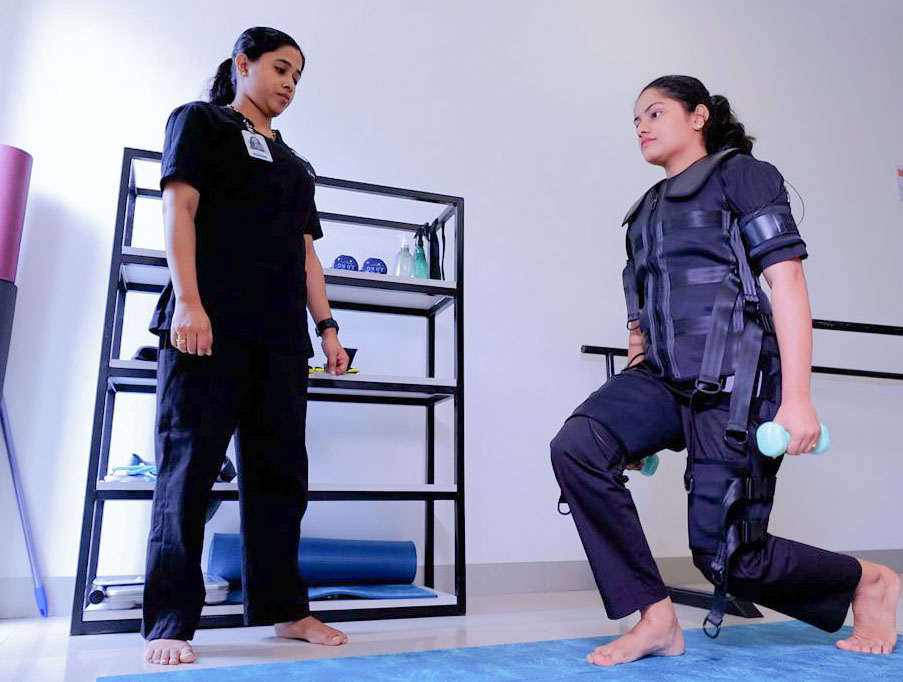
This is the hands-on part of the assessment. Your physiotherapist will examine your body to understand what is actually happening structurally and functionally.
Depending on your condition this may include:
Posture and movement analysis. You will be asked to stand, sit, walk, or perform specific movements. The physiotherapist observes how you move, where you compensate, and what your natural posture looks like.
Range of motion testing. How far can you move the affected joint or body part in each direction? Where does movement become restricted or painful?
Strength testing. Specific muscle groups will be tested manually to identify weakness or imbalance contributing to your problem.
Neurological testing. If nerve involvement is suspected — for example in back pain with leg symptoms or neck pain with arm symptoms — your physiotherapist will test reflexes, sensation, and nerve tension.
Special clinical tests. Condition-specific tests that help confirm or rule out particular diagnoses. For example, tests for rotator cuff integrity, meniscus involvement, or nerve root compression.
You will be asked to move into positions that may reproduce your pain. This is intentional — it helps the physiotherapist identify exactly what is causing the problem. Tell them clearly what you feel at each point.
Step 3: Diagnosis and Explanation (10 Minutes)
After the examination, your physiotherapist will explain what they have found.
This is an important part of the session. You should leave with a clear understanding of:
- What the problem actually is
- Why it is causing your symptoms
- What the treatment plan looks like
- How many sessions are likely needed
- What your realistic recovery timeline is
Do not leave without this information. If anything is unclear, ask. A good physiotherapist will take the time to explain until you fully understand your condition.
Step 4: Initial Treatment (15 to 20 Minutes)
In most cases your physiotherapist will begin treatment in the first session if time allows and if it is appropriate for your condition.
This might include:
- Manual therapy to a stiff joint or tight muscle
- Initial therapeutic exercises
- Taping or strapping for support
- Electrotherapy for pain relief
- Advice on positioning, posture, or activity modification
For some acute or very painful conditions, the first session may be assessment only. Your physiotherapist will explain why if this is the case.
Step 5: Home Exercise Prescription
Before you leave, you will receive home exercises. These are specific to your condition and your body — not a generic printout.
Take these seriously. The work you do between sessions is as important as the treatment you receive in the clinic. Patients who are consistent with home exercises recover significantly faster than those who are not.
Your physiotherapist will demonstrate each exercise and check that you are performing them correctly before you leave.
What the Assessment Feels Like
Most of the assessment is not painful. Movement testing may reproduce some of your usual pain — this is expected and helpful. Manual examination of specific structures may cause brief tenderness.
If at any point something causes unexpected or sharp pain, tell your physiotherapist immediately. The assessment should never be a source of significant additional pain.
Wear comfortable, loose clothing that allows access to the area being assessed. For lower back or hip problems, shorts are helpful. For shoulder or neck problems, a sleeveless top or a top that can be easily removed.
How Long Does the First Session Take?
Allow 45 to 60 minutes for your first appointment. Follow-up sessions are typically 30 to 45 minutes.
What Happens After the First Session?
Your physiotherapist will confirm the treatment plan and book your follow-up sessions. They will give you clear instructions on what to do and what to avoid before your next appointment.
Most patients experience some improvement within the first two to three sessions. If you do not notice any change after four to six sessions, tell your physiotherapist. The plan should be reassessed and adjusted.
Frequently Asked Questions
Do I need to fast or prepare anything specific before my appointment? No. Eat and drink normally. Just bring any relevant medical reports and wear comfortable clothing.
Can I bring someone with me? Yes. You are welcome to bring a family member or carer, particularly if you need help with transport or communication.
What if my pain is very severe on the day of the appointment? Come anyway. Severe pain is clinically useful information. Your physiotherapist will adapt the assessment to your pain level and will not force movements that significantly worsen your condition.
Will I get a diagnosis at the first session? In most cases yes. Some complex conditions require imaging or specialist referral before a definitive diagnosis can be made. Your physiotherapist will tell you clearly if this is needed.
How soon can I book a follow-up after the first session? Follow-up sessions are typically booked on the same day. For most conditions, sessions two to three times per week in the early stages of treatment produce the best results.
Your first session at Maana Health is a free assessment. No obligation. Just a clear, honest picture of what is going on and what it will take to fix it. Book today at one of our five clinics across Kerala — Kochi, Calicut, Perinthalmanna, Aluva, and Trivandrum. Book your free assessment.