
Did you know that most people struggling with persistent back pain wait an average of six months before seeking specialized help? You might think that “pushing through” or resting on a firm mattress is the responsible thing to do, but for many, these common reactions are actually the very things keeping them in a cycle of pain. If you’ve been told that your back pain is just a “part of getting older” or that your only options are surgery or a lifetime of painkillers, you’ve been misled.
In Kerala, and specifically when looking for a physiotherapy clinic in Perinthalmanna, the sea of traditional options can be overwhelming. Most clinics rely on the same old heat packs and manual stretching routines that haven’t changed in decades. But your spine is complex, and your recovery should be too. Understanding the mistakes you might be making right now is the first step toward getting back those healthy years of life you’ve been missing.
Is staying in bed actually making your back worse?
It sounds logical: if it hurts to move, you should stay still. For a long time, bed rest was the standard prescription for back pain. However, we now know that prolonged inactivity is one of the biggest mistakes you can make. When you stop moving, the muscles supporting your spine: your core and paraspinals: begin to weaken and stiffen. This lack of movement also reduces blood flow to the spinal discs, which rely on motion to “pump” in nutrients and clear out waste.
Instead of healing, your back becomes more vulnerable to re-injury. Clinical evidence suggests that gentle, controlled movement is far superior to lying flat. The goal isn’t just to move, but to move in a way that doesn’t aggravate the underlying issue. This is why a personalized treatment protocol is essential. It moves you away from the “rest and wait” mentality and toward active, technology-supported recovery.
Why are painkillers failing to solve the root cause?
It’s tempting to reach for a bottle of pills when the stabbing pain in your lower back makes it hard to stand. While medication can offer temporary relief from the symptoms of inflammation, it does absolutely nothing to fix the structural issue causing the pain in the first place. Whether it’s a herniated disc (where the soft center of a spinal disc pushes through a crack in the tougher exterior) or spinal stenosis (a narrowing of the spinal canal that compresses the nerves), a pill cannot physically realign or decompress your spine.
Relying solely on medication often creates a false sense of security. You might feel “fine” enough to perform an activity that further damages your spine because your body’s natural alarm system: pain: has been silenced. In many cases, this leads to a worsening of the condition over time. True recovery requires addressing the mechanical issues of the spine through advanced modalities rather than just chemical masking.
Does a herniated disc always mean you need surgery?
One of the most common misconceptions we hear is that once a disc is damaged, surgery is the only “real” fix. This fear often prevents people from seeking help until their condition is dire. However, the vast majority of spinal issues can be managed effectively without ever going under the knife. Surgery should always be the last resort, not the first stop.
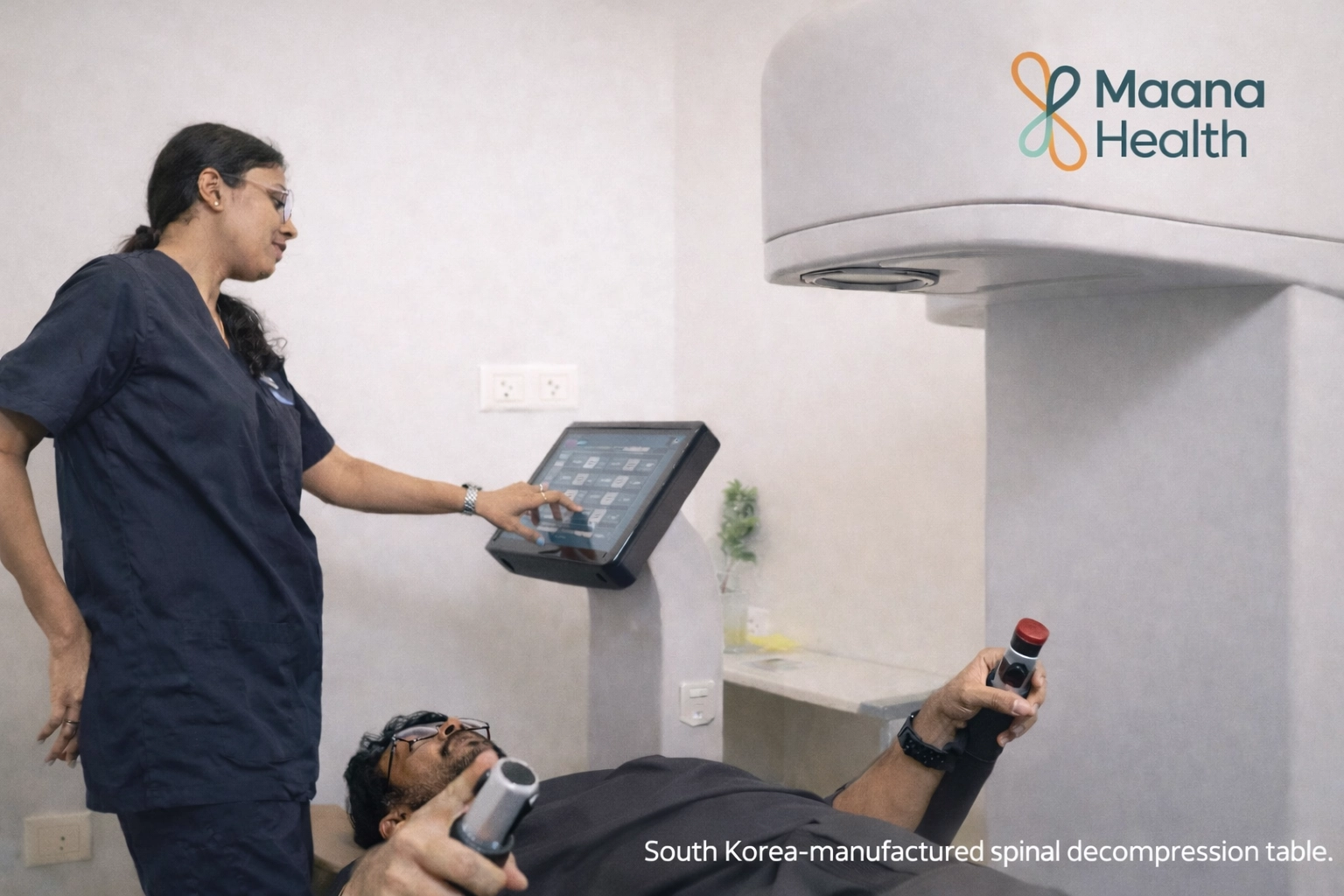
The spinal wellness program at Maana Health focuses on non-surgical and no side effects recovery. We use FDA and CE-approved technology, like spinal decompression beds, to do what manual therapy alone often cannot. These beds work by gently stretching the spine, creating a vacuum effect: known as negative intradiscal pressure: that can help pull a bulging or herniated disc back into place. This isn’t a “massage”; it’s a precise, evidence-based clinical procedure designed to promote disc healing.
What actually happens during spinal decompression?
If you’ve been searching for a physiotherapy clinic in Perinthalmanna, you’ve likely seen clinics offering “traction.” It’s important to understand that modern spinal decompression is a major technological leap beyond old-fashioned traction. While traditional traction pulls the entire spine with a constant force, which can sometimes cause muscles to spasm in resistance, advanced decompression technology is much smarter.
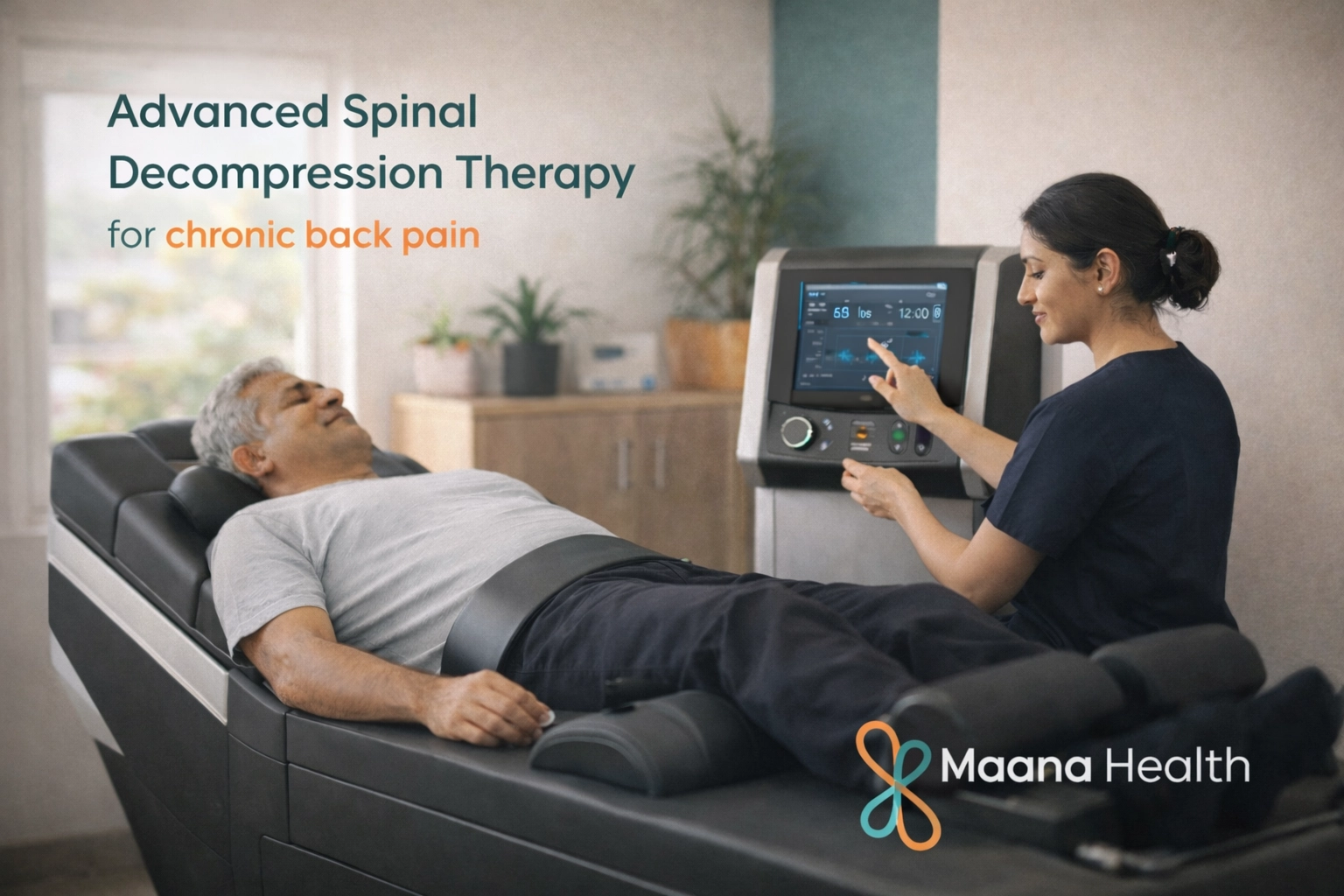
Our decompression tables, such as TheraMaster by Shinhwa Medical and the KNX-7000 by Hanmed, use sophisticated sensors to detect your body’s muscle resistance. These advanced systems are manufactured in South Korea. If the machine senses your muscles tightening, it adjusts the pull in real-time. This allows the spine to relax, ensuring the force reaches the specific disc that needs help. By creating that negative pressure, we encourage the flow of oxygen and nutrient-rich fluids into the disc, which is the “root cause” approach to healing.
Why is focusing only on the “sore spot” a mistake?
Many patients come to us frustrated because they’ve had “localized” treatment for months with no results. They’ve had heat packs or manual rubbing on their lower back, but the pain persists. This is because the site of the pain is often not the source of the problem. For instance, if you have sciatica: pain that radiates down your leg: the problem isn’t your leg; it’s a pinched nerve in your lower spine.
A pioneer in Kerala for this technology-led approach, Maana Health looks at the biomechanics of your entire body. We don’t just treat where it hurts; we use advanced diagnostic logic to identify why that area is being stressed. Is it a loss of spinal curvature? Is it a specific disc level that has lost its height? By using clinical modalities that target these structural issues, we ensure that the relief you feel isn’t just a temporary distraction.
Are you settling for “passive” treatments?
If your current physiotherapy routine consists mostly of you lying on a table while a machine hums or someone rubs your back, you are receiving “passive” treatment. While these can feel good in the moment, they rarely lead to long-term changes in chronic conditions. Advanced physiotherapy should be a bridge from pain relief to functional strength.
In our clinic, we combine the power of decompression with targeted rehabilitation. Once the technology has helped reduce the pressure on your nerves and started the disc healing process, we guide you through specific movements to stabilize your spine. This isn’t about general fitness; it’s about “waking up” the tiny stabilizer muscles that have gone dormant during your months of pain. This combination is why we have 10,000+ patients treated successfully across our network.
How do you choose the right physiotherapy clinic in Perinthalmanna?
Finding the right clinic isn’t just about finding the one closest to your house. When you are dealing with your spine, accuracy is non-negotiable. You should look for a clinic that prioritizes objective data over guesswork. Ask yourself:
- Does the clinic use FDA/CE-approved technology, or just basic equipment?
- Do they have a specific protocol for your condition, or is it the same treatment for everyone?
- Are they focused on non-surgical recovery, or are they just a waiting room for surgery?
At Maana Health, we’ve brought international standards of spinal care to Perinthalmanna. We believe that you deserve more than just a quick fix. We provide an environment where clinical credibility meets a warm, human touch. Our team explains your lower back pain symptoms in plain language, so you actually understand what is happening inside your body.
Moving forward with confidence
Chronic back pain can make your world feel very small. It limits where you go, how long you can play with your children or grandchildren, and how you perform at work. But remember: your spine is resilient. With the right technology-led approach and a commitment to addressing the root cause, most people can find significant relief and return to the activities they love.
Stop settling for treatments that only scratch the surface. If you are tired of the cycle of pills, rest, and temporary relief, it’s time to see what advanced, non-surgical rehabilitation can do for you. Your journey back to a pain-free life doesn’t have to involve surgery: it just involves the right science.

If you’re ready to stop making these common mistakes and start a path toward real recovery, we are here to help. Our team can help you understand exactly what’s happening with your spine and create a roadmap to get you moving again.
Speak to one of our physiotherapists today and take the first step toward more healthy years of life.