
Did you know that nearly 90% of people diagnosed with a herniated disc can achieve a full recovery without ever stepping foot into an operating theater? If you have been told that surgery is your only “permanent” option for chronic back pain, you are likely looking at an incomplete picture of modern medical science.
In Kochi, many people live with the constant shadow of spinal discomfort, thinking their only choices are temporary painkillers or a risky surgical procedure. You might be worried about the long recovery times, the risk of scar tissue, or the fear of “failed back surgery syndrome”: a condition where pain persists even after a technically successful operation.
At Maana Spine, Joint & Wellness Clinic, Kochi, we believe you deserve a treatment plan that respects your natural anatomy while using the most advanced technology available globally. The way we treat the spine has changed fundamentally, shifting away from invasive cuts and toward precise, evidence-based mechanical repair.
Why does your back keep hurting even after rest and medicine?
If you have tried resting for weeks or taking anti-inflammatory pills only for the pain to return the moment you pick up a grocery bag, there is a simple reason. Most traditional treatments focus on the symptoms: the pain: rather than the root cause.
Think of your spine as a series of cushions (discs) between bones (vertebrae). When a disc is compressed, it can bulge or leak, putting pressure on nearby nerves. This is often what causes sciatica: a sharp, radiating pain that travels down your leg.
Painkillers might dull the signal your brain receives, but they don’t move the disc back into place. To get lasting relief, you have to address the mechanical pressure. Clinical evidence suggests that unless you fix the underlying structural issue, the cycle of pain and inflammation will simply continue.
Is surgery really the only way to “fix” a bulging disc?
For a long time, the medical world believed that once a disc was damaged, it had to be physically trimmed or removed through surgery. However, modern non-surgical back pain treatment has turned this idea on its head.
When you undergo surgery, the surgeon often has to cut through muscle and ligament to reach the spine. This can lead to instability and the formation of scar tissue, which can sometimes be more painful than the original injury.
Our approach at Maana Spine, Joint & Wellness Clinic, Kochi, focuses on preserving your natural spinal structure. By using non-invasive methods, we avoid the risks of infection and the long, painful rehabilitation periods associated with surgery. We aren’t just managing your pain; we are creating the environment your body needs to heal itself.
What actually happens during advanced spinal decompression?
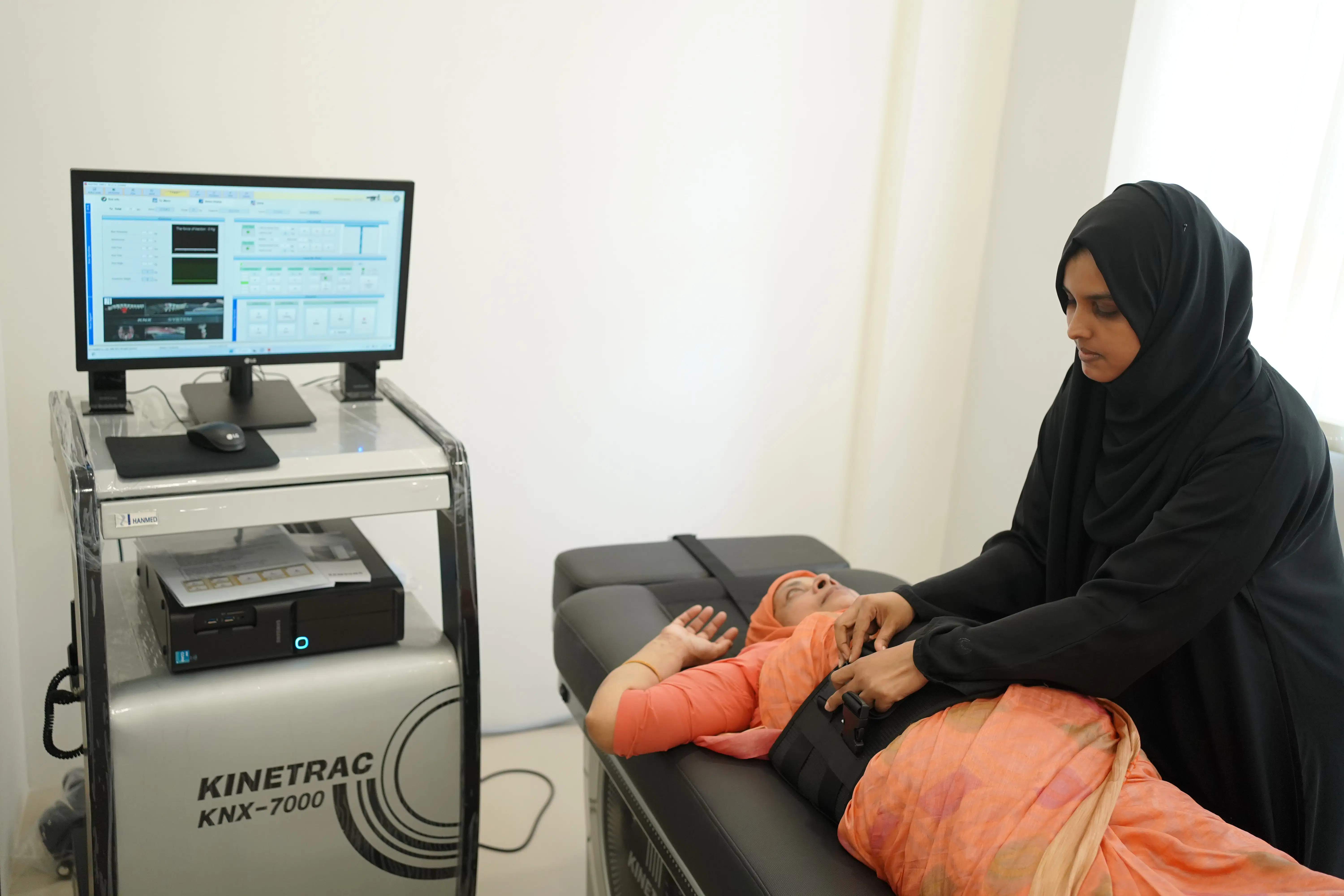
You might have heard of “traction,” but the advanced spinal decompression we use is a completely different level of technology. We employ US FDA and European CE-approved systems like the Kinetrac KNX-7000 and TheraMaster, both engineered in South Korea.
Unlike old-fashioned traction, which pulls the entire spine uniformly, these machines are computer-controlled and highly specific. The Kinetrac KNX-7000 uses automated targeting to identify the exact vertebral segment: like your L4 or L5: that is causing the trouble.
It creates a gentle, rhythmic “vacuum effect” (negative intradiscal pressure) within the damaged disc. This vacuum helps draw the herniated disc material back toward the center of the disc and away from the nerve root. It also encourages the flow of oxygen and nutrients into the disc, which is essential for tissue repair.
How does technology make physiotherapy more effective?
Many people think of a physiotherapy clinic as a place for simple stretches and heat packs. While manual techniques have their place, they often cannot reach the deep structures of the spine with enough force or precision to change the position of a disc.
At Maana Spine, Joint & Wellness Clinic, Kochi, we bridge the gap between traditional therapy and advanced medical engineering. For example, the TheraMaster system allows for multi-angle decompression. This means we can treat the spine while it is in different positions, which is crucial for patients who have spondylosis or complex curvature issues.
This technology-led rehabilitation is non-surgical and has no side effects. Because the computer monitors your body’s muscle resistance in real-time, it can adjust the tension thousands of times per second. This prevents your muscles from “guarding” or spasming, making the treatment both comfortable and incredibly effective.

Can Hyperbaric Oxygen Therapy speed up your recovery?
Spine issues are almost always accompanied by significant inflammation. When a nerve is pinched, it becomes swollen and “angry,” which contributes to that burning or electric shock sensation you might feel.
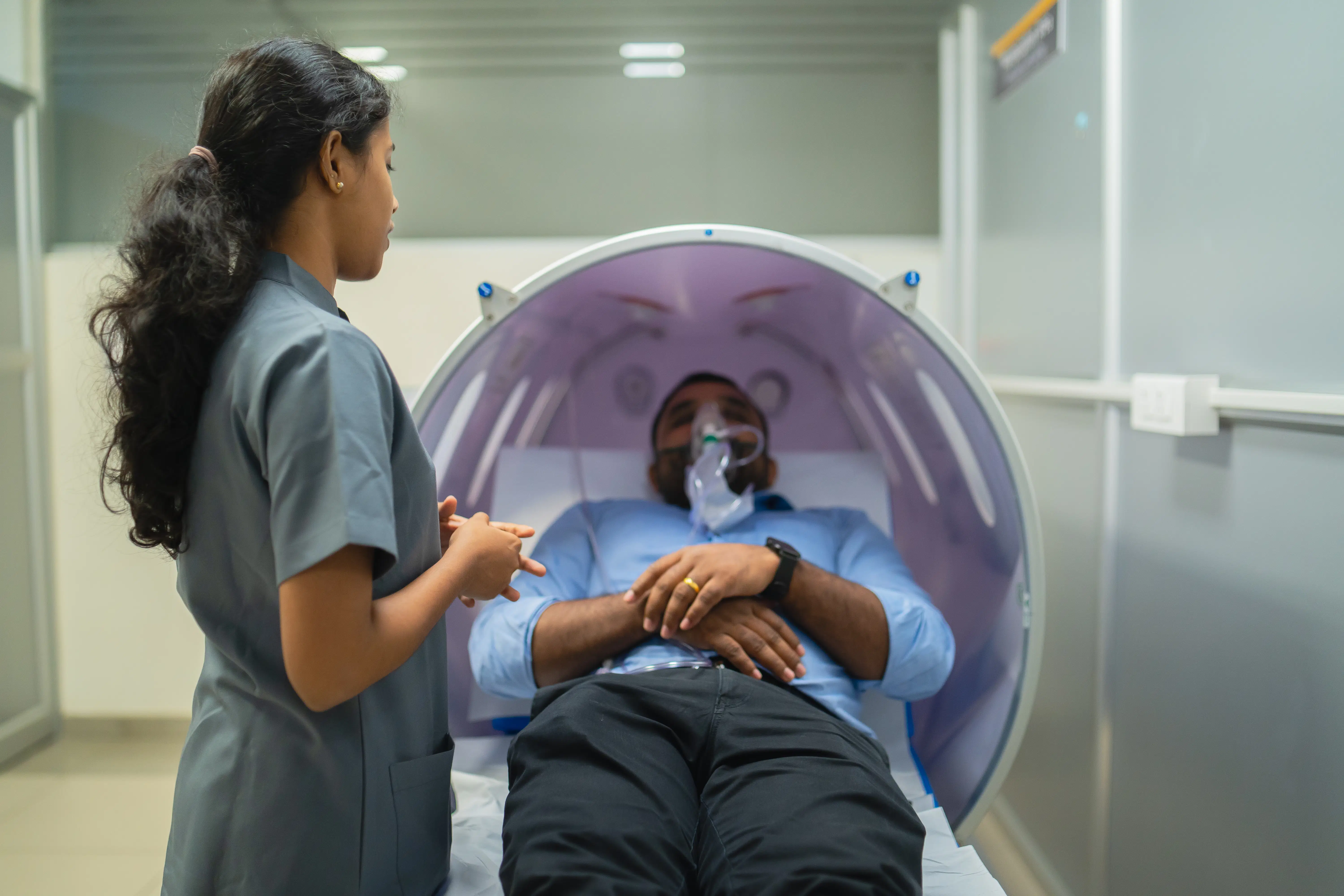
To tackle this, we often integrate Hyperbaric Oxygen Therapy (HBOT) into our programs. In an HBOT chamber, you breathe pure oxygen at increased atmospheric pressure. This allows oxygen to dissolve into your blood plasma and reach areas with poor circulation: like your spinal discs: at much higher concentrations than normal.
This extra oxygen accelerates tissue regeneration and drastically reduces inflammation. By combining HBOT with spinal decompression, we address the mechanical issue (the pressure) and the biological issue (the inflammation) at the same time. This dual-action approach is part of why our results are so consistent.
What happens after the pain is gone?
The biggest mistake most people make is stopping their treatment the moment the pain disappears. Pain is often the last symptom to arrive and the first to leave. Just because you feel better doesn’t mean your spine is stable.
Once we have relieved the pressure on your nerves using our South Korean decompression technology, we move into the “stabilization” phase. We focus on strengthening your deep core muscles: the “internal corset” that holds your spine in place.
If these muscles are weak, your spine will eventually slump back into the same poor positions that caused the injury in the first place. Our specialized programs in Kochi are designed to give you more healthy years of life by teaching you how to move, sit, and lift in ways that protect your recovery.
Is this approach right for your specific condition?
You might be wondering if this works for your specific diagnosis. Whether you are dealing with a bulging disc, degenerative disc disease, or even facet syndrome, the goal remains the same: restore space, reduce inflammation, and rebuild strength.
In many cases, patients who were scheduled for surgery find that after a personalized treatment protocol of about 18 to 24 sessions, their symptoms have improved so significantly that surgery is no longer necessary. This is the power of a root-cause focused approach.
We also see many patients for knee pain treatment without surgery. The same principles of decompression and advanced tissue healing apply across our musculoskeletal programs, ensuring that your entire body is functioning in harmony.
Take the first step toward a pain-free life
You don’t have to accept chronic back pain as your “new normal,” and you don’t have to rush into a surgical procedure that you aren’t comfortable with. The technology available today has opened up a middle ground: one that is evidence-based, clinically validated, and focused on long-term wellness.
At Maana Spine, Joint & Wellness Clinic, Kochi, we have helped thousands of patients reclaim their mobility and their lives. Our team is here to listen to your story, look at your scans, and help you understand exactly what is happening inside your body.
If you are tired of temporary fixes and are ready to address the root cause of your pain, we invite you to speak with one of our physiotherapists for a detailed assessment. Let’s work together to get you back to the activities you love, without the need for surgery.