
Authored by Ashitha Abdul Ashraf, Senior Consultant Physiotherapist – Incharge | Medically Reviewed by Dilshana Thasni T, Senior Consultant Physiotherapist | Last Reviewed: June 2026
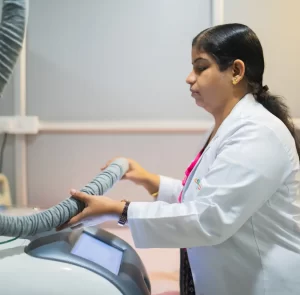
If your doctor or physiotherapist has mentioned shockwave therapy and you are not sure what it involves, this guide covers everything you need to know before your first session — what it is, what it treats, what the session feels like, and what results to realistically expect.
What Is ESWT?
Extracorporeal Shockwave Therapy delivers high-energy acoustic waves into damaged tissue from outside the body. Extracorporeal simply means outside the body — there are no incisions, no needles for the treatment itself, and no anaesthesia required.
A handheld applicator is placed on the skin over the target tissue. Acoustic waves generated by the device penetrate through the skin to reach the damaged tendon, calcification, or affected area beneath.
At Maana Health, ESWT is delivered using FDA and CE-approved equipment — the same standard used in specialist rehabilitation centres across Europe, North America, and major Indian cities.
How Is It Different from Ultrasound Therapy?
This is a common question. Both involve waves delivered through the skin. They are fundamentally different treatments.
Therapeutic ultrasound uses continuous or pulsed sound waves at low energy to warm deep tissue and promote blood flow. It is gentle and has been used in physiotherapy for decades. It works well for mild soft tissue conditions.
ESWT delivers high-energy acoustic pulses — significantly more powerful than therapeutic ultrasound — that create a mechanical effect in the tissue. This mechanical effect stimulates collagen production, breaks down calcification, and disrupts the abnormal nerve fibres that cause chronic tendon pain. The two treatments are not interchangeable.
Why Chronic Tendon Pain Does Not Respond to Rest or Anti-Inflammatories
Understanding this changes how you think about your treatment.
When tendon pain has been present for more than 6 to 12 weeks, the underlying pathology is no longer inflammation. It has progressed to tendinosis — a degenerative process where the normal tendon architecture breaks down at a cellular level. Abnormal blood vessels and nerve fibres grow into the tendon. The tissue loses its normal structure and load-bearing capacity.
Anti-inflammatory drugs — ibuprofen, diclofenac — address inflammation. They do not address tendinosis. This is why they provide temporary relief for chronic tendon pain but not durable resolution.
Rest removes the load that is aggravating the tendon. It does not stimulate the repair process needed to reverse tendinosis. This is why rest alone consistently fails for chronic tendon conditions.
ESWT stimulates the repair process directly — triggering collagen production, breaking down degenerative tissue, and reducing the abnormal nerve ingrowth that is generating the pain signal.
Conditions ESWT Treats
Plantar fasciitis (chronic heel pain)
The strongest evidence base for ESWT across all conditions. For heel pain that has persisted more than three months and failed stretching, orthotics, and basic physiotherapy, ESWT is the treatment of choice in most international sports medicine guidelines before surgery is considered. Success rates above 70% in clinical trials.
Calcific tendinitis of the shoulder
Calcium deposits in the rotator cuff tendon cause severe shoulder pain and restricted movement. ESWT physically breaks down and disperses the calcium deposits — something no other non-surgical treatment achieves. Calcium dissolution occurs in 60 to 80% of cases.
Achilles tendinopathy
Chronic pain in the Achilles tendon responds well to ESWT combined with specific loading exercise. The combination consistently outperforms either treatment alone.
Patellar tendinopathy (jumper’s knee)
Chronic pain at the base of the kneecap in jumping athletes. One of the most difficult tendon conditions to treat. ESWT accelerates recovery in cases that have not responded to exercise therapy alone.
Tennis elbow (lateral epicondylalgia)
Chronic outer elbow pain from extensor tendon degeneration. Strong evidence for ESWT in cases present more than six months.
Golfer’s elbow (medial epicondylalgia)
Inner elbow tendon degeneration. Good clinical outcomes with ESWT.
Greater trochanteric pain syndrome
Outer hip pain from gluteal tendinopathy. ESWT evidence is growing and clinical results are consistently positive.
Chronic muscle trigger points
Focal areas of muscle contracture that generate referred pain. ESWT reduces trigger point activity and associated pain.
What the Session Feels Like
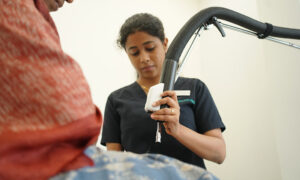
You sit or lie comfortably with the treatment area accessible. Ultrasound gel is applied to the skin — this allows the acoustic waves to transmit through the skin without air resistance.
The handheld applicator is placed on the skin and moved slowly over the target tissue. You will feel a rhythmic pulsing sensation. Most patients describe it as mildly uncomfortable rather than painful — similar to a firm tapping sensation. The intensity is adjustable and is set based on your feedback and tolerance.
Each session lasts 15 to 20 minutes for the ESWT component. Full appointments including assessment and any additional physiotherapy are 30 to 45 minutes.
Mild soreness in the treated area for 24 to 48 hours after the first one or two sessions is common. This is the therapeutic inflammatory response being stimulated and settles quickly. Most patients find subsequent sessions progressively more comfortable as the tissue begins to respond.
Number of Sessions and Spacing
A standard course is 3 to 5 sessions, spaced one week apart.
This is one of ESWT’s significant practical advantages. Many effective physiotherapy treatments require 12 to 20 sessions over months. ESWT achieves its primary effect in 3 to 5 sessions.
The tissue repair process stimulated by ESWT continues for weeks after the final session. Full results are assessed 4 to 6 weeks after completing the course. Many patients continue to improve for 2 to 3 months after the last treatment.
For calcific tendinitis, a second course of 3 sessions may be needed if calcium deposits have not fully resolved after the first course.
What to Do and Avoid After Each Session
For 48 hours after each session:
Avoid anti-inflammatory medication — ibuprofen, diclofenac, naproxen. These suppress the inflammatory response that ESWT is deliberately triggering. Taking NSAIDs after a session directly counteracts the treatment mechanism. Paracetamol is acceptable for pain management if needed.
Avoid ice on the treated area for the same reason.
Avoid high-load activity on the treated tendon — running, jumping, heavy lifting. Light to moderate activity is fine and encouraged.
Who Is Not Suitable for ESWT
Your physiotherapist will screen for contraindications before treatment begins. ESWT is not suitable if you have:
- A blood clotting disorder or are taking anticoagulant medication (warfarin, rivaroxaban, apixaban)
- Active infection or tumour in the treatment area
- Treatment area over a growth plate in a child or adolescent
- Pregnancy
- A cardiac pacemaker if the treatment area is near the chest
- A cortisone or steroid injection in the treatment area within the previous 6 weeks
ESWT vs Steroid Injection: What the Research Shows
Many patients arrive at ESWT after one or more steroid injections. This is a common pathway in Kerala and across India.
Steroid injections produce faster initial pain relief — often within days. This is their advantage. The research on long-term outcomes is different.
Multiple studies comparing steroid injection to ESWT for chronic tendinopathy show steroid produces better short-term relief at 4 to 8 weeks. ESWT produces better outcomes at 12 months and beyond. The durability gap is consistent across conditions.
There is also evidence that repeated steroid injections weaken tendon tissue structurally, increasing rupture risk. The current consensus in sports medicine is that ESWT is the preferred intervention for chronic tendinopathy and steroid injections should be used sparingly if at all for these conditions.
Realistic Outcomes
For suitable candidates — chronic tendon pain present more than 3 months, failed basic conservative treatment:
- Significant improvement in approximately 70 to 80% of patients
- Plantar fasciitis success rates consistently above 70% at 3 months in clinical trials
- Calcific tendinitis calcium dissolution in 60 to 80% of cases
- Approximately 20 to 30% of patients do not respond adequately to a single course
ESWT is not a guaranteed cure. If you do not respond to a complete course, your physiotherapist will discuss further options — which may include a second course, additional physiotherapy, injection therapy, or surgical referral depending on the condition.
ESWT at Maana Health: What to Expect
At Maana Health, ESWT is not delivered as a standalone treatment. It is integrated into a comprehensive management plan that includes:
- A thorough assessment to confirm diagnosis and suitability
- ESWT sessions with experienced physiotherapists
- Specific loading exercise program for the tendon — the combination of ESWT and targeted exercise consistently outperforms either alone
- Load management guidance for your daily activities and sport
- Progress reassessment at 4 to 6 weeks post-treatment
Frequently Asked Questions
How quickly will I notice improvement?
Some patients notice improvement within the first two sessions. For most, meaningful improvement is apparent 4 to 6 weeks after completing the course as the tissue repair process progresses. Full results are assessed at 3 months post-treatment.
I have had heel pain for two years. Is ESWT still worth trying?
Yes. Duration of symptoms does not significantly reduce the likelihood of response to ESWT. Long-standing plantar fasciitis responds at similar rates to more recent cases.
Can I continue sport during a course of ESWT?
Light to moderate activity is encouraged. High-load activity on the treated tendon should be reduced. Your physiotherapist will give specific guidance based on your condition and sport.
Is ESWT painful?
The session involves a pulsing sensation that most patients find mildly uncomfortable rather than painful. Intensity is adjusted throughout the session based on your feedback. Significant pain during a session should be reported immediately.
Is ESWT covered by health insurance in India?
Coverage varies by insurer and policy. Some plans include ESWT under physiotherapy benefits. Maana Health staff can assist with insurance queries before your first session.
Can I have ESWT if I have already had surgery on the affected area?
Depends on the surgery and how long ago it was performed. Disclose your surgical history fully at assessment. Previous surgery does not automatically exclude you from ESWT but changes the assessment of suitability.
ESWT is available at all five Maana Health clinics across Kerala — Kochi, Calicut, Perinthalmanna, Aluva, and Trivandrum. If you have chronic tendon pain that has not responded to rest, medication, or basic physiotherapy, book a free assessment to find out whether ESWT is right for you.