
Authored by Ashitha Abdul Ashraf, Senior Consultant Physiotherapist – Incharge | Medically Reviewed by Dilshana Thasni T, Senior Consultant Physiotherapist | Last Reviewed: June 2026
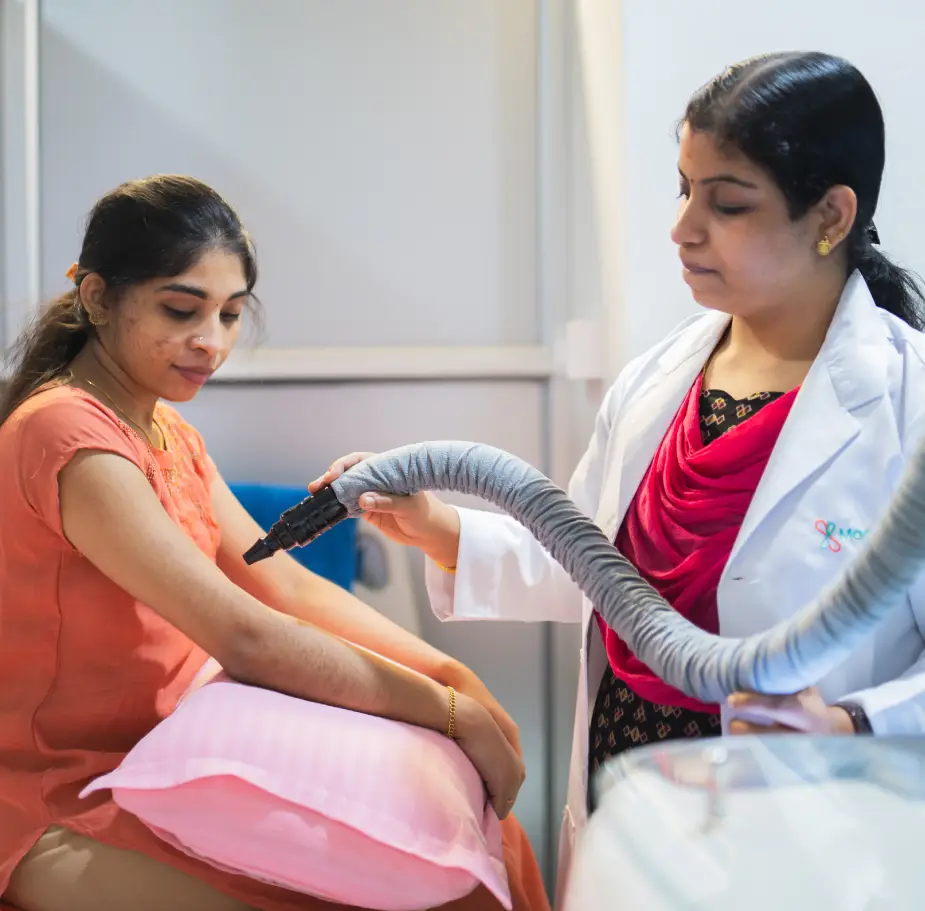
If you have had tendon pain for more than three months and physiotherapy exercises have not resolved it, shockwave therapy is probably the most important treatment option you have not tried yet.
Chronic tendon pain is one of the most frustrating conditions in musculoskeletal medicine. It does not respond to rest. It does not respond to anti-inflammatory medication. It often does not respond to basic physiotherapy. And yet millions of people in India continue to be managed with exactly these approaches — often for years — before anyone mentions shockwave therapy.
This guide explains what shockwave therapy is, what the evidence says, which conditions it treats, and what a realistic course of treatment looks like.
What Is Shockwave Therapy?
Extracorporeal Shockwave Therapy — ESWT — delivers high-energy acoustic waves into damaged tissue from outside the body. The word extracorporeal simply means outside the body. No incisions. No needles for the treatment itself. No anaesthesia.
The acoustic waves are generated by a handheld applicator placed on the skin over the target tissue. They penetrate through skin and soft tissue to reach the damaged tendon or area of calcification.
At Maana Health, ESWT is delivered using FDA and CE-approved equipment. This is not a fringe treatment. It is used in specialist sports medicine and rehabilitation centres across Europe, North America, and Asia, and has been available in major Indian cities for over a decade.
How It Works
Chronic tendon conditions are not inflammation problems. This is one of the most important — and most misunderstood — facts in musculoskeletal medicine.
When a tendon is in pain for more than 6 to 12 weeks, the pathology changes from inflammation (tendinitis) to a degenerative process (tendinosis). The tendon tissue breaks down at a cellular level. Abnormal blood vessels and nerve ingrowth occur. The normal tendon architecture is disrupted.
Anti-inflammatory medication does not fix tendinosis. It addresses inflammation that is no longer the primary driver of the problem. This is why NSAIDs and steroid injections frequently provide temporary relief for chronic tendon pain but do not produce durable resolution.
Shockwave therapy works through different mechanisms.
Stimulates collagen production. The acoustic waves trigger a controlled injury response in the tendon tissue — stimulating the production of new collagen and restarting the repair process that has stalled in chronically degenerated tendons.
Breaks down calcification. For calcific tendinitis — calcium deposits within the tendon — shockwave therapy mechanically disrupts and disperses the calcium deposits. This is something no other non-surgical treatment achieves.
Reduces nerve ingrowth. The abnormal nerve fibres that grow into a chronically degenerated tendon are a primary source of pain. ESWT disrupts these nerve fibres, reducing pain signals from the tendon.
Promotes neovascularisation. Increases healthy blood vessel formation in the tendon, improving nutrient delivery and supporting tissue repair.
The net result is a tendon that is stimulated to repair, not just managed for symptoms.
Conditions ESWT Treats Effectively
Plantar Fasciitis (Heel Pain)
The strongest evidence base for ESWT is in plantar fasciitis. Multiple randomised controlled trials consistently show ESWT produces significant improvement in chronic plantar fasciitis — particularly cases that have failed stretching, orthotics, and basic physiotherapy.
For patients who have had heel pain for more than three months, ESWT is considered the treatment of choice by most sports medicine guidelines before surgical intervention is considered.
Most patients with chronic plantar fasciitis notice meaningful improvement within 4 to 8 weeks of completing a course of ESWT.
Calcific Tendinitis of the Shoulder
Calcium deposits in the supraspinatus tendon cause severe shoulder pain and significantly restricted movement. ESWT is the most effective non-surgical treatment for this condition — directly breaking down the calcium deposits and stimulating tendon repair.
Studies show ESWT achieves calcium deposit dissolution in 60 to 80% of cases, with significant pain reduction and functional improvement in the majority of patients. The alternative is ultrasound-guided needling or surgical removal. ESWT is lower risk and produces comparable outcomes in most cases.
Achilles Tendinopathy
Chronic Achilles tendinopathy — pain at the back of the heel or in the mid-substance of the tendon — responds well to ESWT, particularly when combined with eccentric and heavy slow resistance exercise.
The combination of ESWT and specific tendon loading exercise consistently outperforms either treatment alone in the research literature. For athletes with chronic Achilles tendinopathy who have not responded to exercise alone, adding ESWT to the program produces meaningful improvement in the majority of cases.
Patellar Tendinopathy (Jumper’s Knee)
Chronic pain at the base of the kneecap in jumping athletes. Patellar tendinopathy is notoriously difficult to treat and often takes 6 to 12 months to resolve even with excellent rehabilitation.
ESWT accelerates recovery in chronic patellar tendinopathy. Multiple trials show significant improvement in pain and function in athletes who have not responded to exercise therapy alone. It is considered a standard treatment option in elite sports medicine for this condition.
Tennis Elbow (Lateral Epicondylalgia)
Chronic pain at the outer elbow from degeneration of the extensor tendon origin. ESWT produces significant improvement in chronic tennis elbow that has failed conservative management. Evidence is particularly strong for cases that have been present for more than 6 months.
Golfer’s Elbow (Medial Epicondylalgia)
Similar mechanism to tennis elbow but affecting the inner elbow. ESWT evidence is good, particularly for chronic cases.
Greater Trochanteric Pain Syndrome (Hip Tendinopathy)
Pain at the outer hip from gluteal tendinopathy or trochanteric bursitis. ESWT evidence is growing and results in clinical practice are consistently positive for cases that have not responded to physiotherapy.
What a Treatment Session Looks Like
A shockwave therapy session is straightforward.
You sit or lie in a comfortable position with the target area accessible. Ultrasound gel is applied to the skin over the treatment area — this helps transmit the acoustic waves. The handheld applicator is placed on the skin and moved slowly over the target tissue.
The treatment produces a repetitive pulsing sensation. Most patients describe it as mildly uncomfortable rather than painful. The intensity is adjusted based on your feedback and tolerance.
Each session lasts approximately 15 to 20 minutes for the shockwave component. The full appointment, including assessment and any additional physiotherapy, is typically 30 to 45 minutes.
Mild soreness in the treated area for 24 to 48 hours after the first one or two sessions is common and normal. This reflects the therapeutic inflammatory response being stimulated. It settles quickly.
How Many Sessions Are Needed?
A standard course of ESWT is 3 to 5 sessions, spaced one week apart.
This is one of the significant advantages of ESWT over other treatments. Spinal decompression requires 15 to 20 sessions. A full physiotherapy program for chronic tendinopathy runs 12 to 16 weeks. ESWT achieves its primary effect in 3 to 5 sessions.
Full results are typically assessed 4 to 6 weeks after the final session. The tissue repair process stimulated by ESWT continues for weeks after the last treatment. Many patients continue to improve for 2 to 3 months after completing the course.
For calcific tendinitis, some cases require a second course of 3 sessions if the calcium deposits have not fully resolved after the first course.
What to Avoid After Each Session
For 48 hours after each shockwave session:
- Avoid anti-inflammatory medication — NSAIDs like ibuprofen. These suppress the inflammatory response that ESWT is deliberately stimulating. Taking anti-inflammatories immediately after ESWT directly counteracts the treatment mechanism.
- Avoid ice on the treated area for the same reason.
- Avoid high-load activity on the treated tendon. Light activity is fine.
Paracetamol is acceptable for pain management after sessions if needed.
Who Is Not a Suitable Candidate
ESWT is not appropriate for everyone. Your physiotherapist will screen for contraindications before treatment begins.
ESWT is not suitable if you have:
- A blood clotting disorder or are taking anticoagulant medication
- Active infection or tumour in the treatment area
- Treatment area over a growth plate in a skeletally immature patient
- Pregnancy
- A cardiac pacemaker if the treatment area is near the chest
- Cortisone injection in the treatment area within the previous 6 weeks — wait at least 6 weeks after any steroid injection before ESWT
ESWT vs Steroid Injection: The Honest Comparison
Many patients come to shockwave therapy after one or more steroid injections. This is a common pathway.
Steroid injections for chronic tendinopathy produce rapid pain relief — often within days. This is their advantage. The problem is durability. Multiple studies show that steroid injections for tendinopathy produce better short-term pain relief than ESWT but worse long-term outcomes. At 12 months, ESWT consistently outperforms steroid injection for chronic tendinopathy.
There is also evidence that repeated steroid injections weaken tendon tissue — increasing the risk of tendon rupture. The current consensus in sports medicine is that steroid injection for chronic tendinopathy should be used sparingly, if at all, and that ESWT is the preferred intervention for chronic cases.
Realistic Outcomes
For suitable candidates — chronic tendon pain present for more than 3 months, failed basic conservative treatment — ESWT produces meaningful improvement in approximately 70 to 80% of patients.
For plantar fasciitis specifically, success rates in clinical trials are consistently above 70% for significant pain reduction at 3 months.
For calcific tendinitis, calcium deposit resolution occurs in 60 to 80% of cases, with pain improvement in the majority even when calcium does not fully dissolve.
ESWT does not work for everyone. Approximately 20 to 30% of patients do not respond adequately. If this applies to you after a complete course, your physiotherapist will discuss further options.
Frequently Asked Questions
How quickly will I notice improvement?
Some patients notice improvement within the first two sessions. For most, meaningful improvement is apparent 4 to 6 weeks after completing the course as the tissue repair process progresses. Full results are assessed at 3 months.
Can I continue exercising during ESWT?
Yes. Light to moderate activity is encouraged. High-load activity on the treated tendon — running, jumping, heavy lifting — should be reduced during the treatment course and reintroduced gradually afterward. Your physiotherapist will give specific guidance based on your condition and activity level.
Is ESWT covered by health insurance in India?
Coverage varies significantly by insurer and policy. Some plans include ESWT under physiotherapy benefits. Check with your insurer before starting treatment. Maana Health staff can assist with insurance queries.
I have had plantar fasciitis for two years. Is it too late for ESWT?
No. ESWT is effective for long-standing chronic tendinopathy. Duration of symptoms does not reduce the likelihood of response significantly. Cases that have been present for two years respond to ESWT at similar rates to cases present for six months.
Can ESWT be combined with other physiotherapy treatments?
Yes — and it should be. ESWT combined with specific loading exercise for the tendon consistently produces better outcomes than ESWT alone. The shockwave stimulates tissue repair. The exercise directs and strengthens the new tissue. Combining both is the current standard of care for chronic tendinopathy.
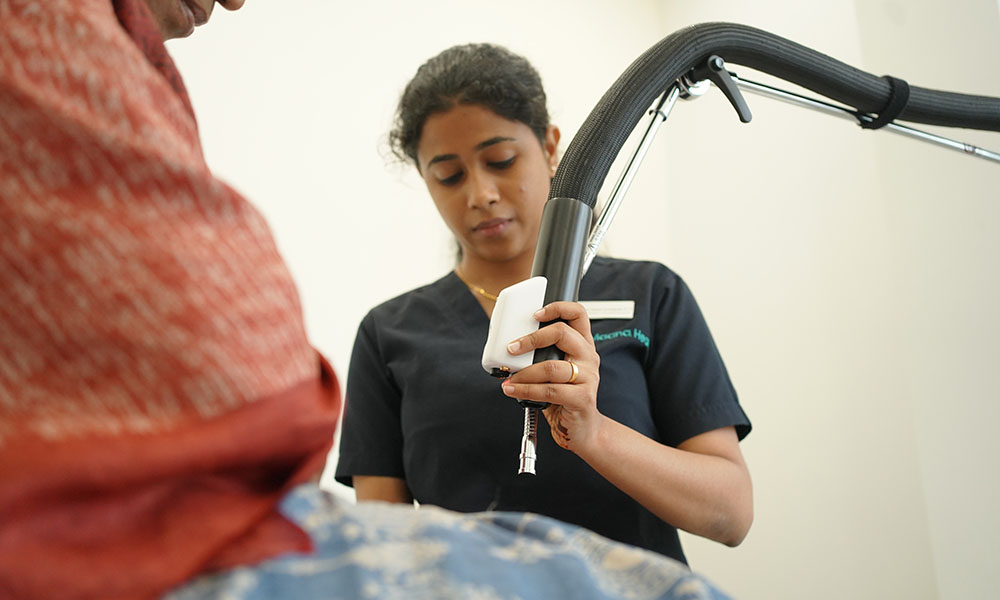
Shockwave therapy (ESWT) is available at Maana Health clinics across Kerala — Kochi, Calicut, Perinthalmanna, Aluva, and Trivandrum. If you have chronic tendon pain that has not responded to rest, medication, or basic physiotherapy, book a free assessment to find out whether ESWT is right for you.