
Authored by Ashitha Abdul Ashraf, Senior Consultant Physiotherapist – Incharge | Medically Reviewed by Dilshana Thasni T, Senior Consultant Physiotherapist | Last Reviewed: June 2026
Herniated Disc vs Bulging Disc: What Is the Difference and Does It Matter for Treatment?

If you have had an MRI for back pain, the report probably mentioned one of two things: a bulging disc or a herniated disc. Maybe both. Your doctor handed you the report, said something about your spine, and sent you on your way.
Now you are sitting at home trying to figure out what it actually means and whether you need surgery.
Here is a clear explanation of what each term means, how they differ, and what the difference actually means for your treatment.
What Is a Spinal Disc?
Before getting into the difference, it helps to understand what a disc is.
Each spinal disc sits between two vertebrae and acts as a cushion and shock absorber. It has two parts: a tough outer ring called the annulus fibrosus, and a soft gel-like centre called the nucleus pulposus.
When the disc is healthy, it keeps the vertebrae separated, absorbs load, and allows your spine to move in multiple directions. When it is damaged or degenerated, it can press on nearby nerves — which is where the pain, numbness, and leg symptoms come from.
Bulging Disc: What It Means
A bulging disc happens when the disc flattens and extends beyond its normal boundary. The outer ring remains intact. The disc is not torn — it is compressed and spreading outward, like a burger patty being pressed down.
Bulging discs are extremely common. Studies consistently show that a significant percentage of people over 40 have bulging discs on MRI with no pain at all. A bulge on your MRI is not automatically the cause of your symptoms. It may be completely incidental.
A bulging disc becomes clinically relevant when it presses on a nerve root or the spinal cord. At that point it causes pain, and potentially numbness, tingling, or weakness in the arms or legs.
Herniated Disc: What It Means
A herniated disc — also called a prolapsed disc, slipped disc, or ruptured disc — is more significant structurally. The outer ring of the disc tears, and the gel-like inner material pushes through the tear.
This herniated material can press directly on a nerve root. It also triggers an inflammatory response that irritates nearby nerves even without direct contact. This is why herniated discs cause the sharp, radiating pain of sciatica — pain that travels from the lower back down the leg, often to the foot.
Herniated discs are most common in the lumbar spine (lower back) at the L4-L5 and L5-S1 levels, and in the cervical spine (neck) at C5-C6 and C6-C7.
The Key Differences
| Bulging Disc | Herniated Disc | |
|---|---|---|
| Outer ring | Intact | Torn |
| Inner material | Contained | Pushed through tear |
| Severity | Generally less severe | Generally more severe |
| Nerve compression | Possible if large | Common |
| Sciatica | Less common | Very common |
| Surgery rate | Low | Low to moderate |
| Response to physio | Good | Good in most cases |
Does the Difference Actually Matter for Treatment?
Honestly, less than most patients expect.
Both conditions are treated conservatively first in the vast majority of cases. The type of disc problem matters less than the clinical picture — your symptoms, your neurological status, and how your body is responding to treatment.
A large disc herniation with minimal nerve compression and no neurological deficit may respond faster to physiotherapy than a moderate bulge that happens to be pressing directly on a nerve root. The MRI finding alone does not determine the treatment pathway. Your clinical presentation does.
What does matter is whether nerve involvement is present and whether it is getting better or worse.
When Conservative Treatment Works
The good news is that most disc problems, whether bulge or herniation, resolve with conservative treatment. Research published in the journal Spine shows that over 90% of lumbar disc herniations improve significantly without surgery within 12 weeks of structured conservative care.
The body has a natural process of reabsorbing herniated disc material over time. Conservative treatment supports and accelerates this process.
Physiotherapy addresses the immediate pain, restores movement, and strengthens the muscles that take load off the disc. A structured program of 8 to 12 weeks is the standard first-line treatment.
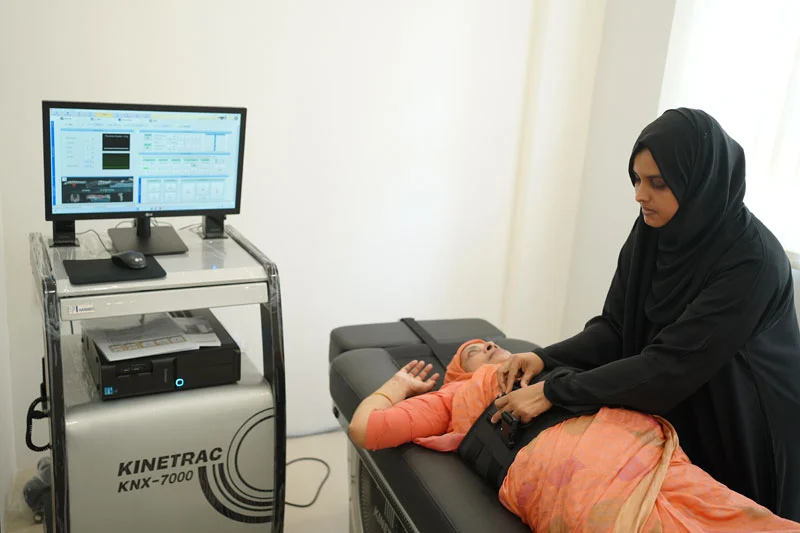
Spinal Decompression Therapy is specifically effective for disc conditions. The KNX-7000 system creates negative intradiscal pressure — gently drawing herniated material away from the nerve and pulling water and nutrients back into the disc. For patients with significant sciatica from a disc herniation, spinal decompression often produces relief that basic physiotherapy and medication cannot achieve alone.
A typical course of spinal decompression is 15 to 20 sessions. Many patients with chronic sciatica notice meaningful improvement within the first 8 to 10 sessions.
Manual therapy mobilises stiff spinal joints and reduces muscle guarding around the affected disc level.
Activity modification reduces load on the disc during the healing phase. Your physiotherapist will advise you on what to avoid and what to continue.
When Surgery Becomes Necessary
Surgery for disc problems is indicated in specific situations, not as a general response to a positive MRI finding.
Cauda equina syndrome is a surgical emergency. If you develop numbness in the groin or inner thighs, or lose bladder or bowel control, go to a hospital immediately. This is not a situation for conservative treatment.
Progressive neurological deficit means increasing leg weakness, spreading numbness, or worsening neurological signs on examination. If your leg is getting weaker despite conservative treatment, surgery becomes appropriate.
Failure of genuine conservative treatment means completing a structured 12-week physiotherapy program without adequate improvement. Two or three sessions does not count. A genuine trial is consistent, structured treatment over the full recommended period.
Pain alone, even severe pain, is rarely a surgical indication for disc problems. Pain is manageable conservatively in most cases. Progressive nerve damage is the line.
What to Do If Your MRI Shows a Disc Problem
Follow these steps in order.
Get a proper clinical assessment before making any treatment decisions. An MRI report tells you what is there. A physiotherapist’s examination tells you whether it is causing your symptoms and what to do about it.
Start conservative treatment immediately. Do not wait. The earlier treatment begins for disc conditions, the better the outcome. Delayed treatment allows the surrounding muscles to weaken and compensate, which extends recovery significantly.
Ask specifically about spinal decompression if you have sciatica. Not all physiotherapy clinics in Kerala have this equipment. If your disc herniation is causing significant leg symptoms, standard physiotherapy exercises alone are unlikely to be sufficient.
Give the treatment a genuine trial. Eight to twelve weeks of consistent physiotherapy. Daily home exercises. If you have not improved adequately after this period, then a surgical opinion is appropriate.
Frequently Asked Questions
Can a herniated disc heal on its own?
Yes. The body reabsorbs herniated disc material over time in the majority of cases. This process takes weeks to months. Conservative treatment accelerates it. Complete healing without treatment takes longer and leaves you in pain during the process.
Is it safe to exercise with a disc herniation?
Yes, with the right exercises prescribed by your physiotherapist. Generic gym exercises or exercises that load the spine in flexion — sit-ups, toe touches, heavy deadlifts — can worsen a herniation. Specific therapeutic exercises prescribed for your disc level and direction of herniation are safe and necessary for recovery.
My pain is in my leg, not my back. Is it still a disc problem?
Possibly. Sciatica — pain radiating down the leg — is frequently caused by disc herniation pressing on the sciatic nerve in the lumbar spine. The disc problem is in your back but the pain is felt in your leg. This is referred nerve pain, not a leg injury.
How do I know if spinal decompression is right for me?
A physiotherapy assessment will determine this. Spinal decompression is appropriate for disc herniations, degenerative disc disease, and sciatica without severe osteoporosis, spinal fractures, or implants. An assessment at Maana Health will tell you clearly whether you are a suitable candidate.
What is the difference between a slipped disc and a herniated disc?
They are the same thing. Slipped disc is a common term used by patients. Herniated disc, prolapsed disc, and ruptured disc all refer to the same structural event — the inner disc material pushing through a tear in the outer ring.
Maana Health treats disc herniations and bulging discs across five clinics in Kerala — Kochi, Calicut, Perinthalmanna, Aluva, and Trivandrum. If your MRI has shown a disc problem and you are not sure what to do next, book a free assessment and we will give you a clear picture of your options.