

Did you know that the average desk worker in Kozhikode now spends upwards of nine hours a day seated? That equates to nearly 2,300 hours a year of static pressure on your lumbar spine. If you have ever stood up after a long afternoon of emails only to feel a sharp twinge in your lower back or a dull ache that lingers until bedtime, you are experiencing the physical toll of the modern “desk-bound” lifestyle.
While Kozhikode’s professional landscape is evolving with more IT hubs and corporate offices, our bodies haven’t quite caught up to the demands of sitting still for eight hours straight. We often treat back pain as an inevitable part of growing older or working hard, but in many cases, it is simply a sign that your environment is working against your anatomy. You deserve more than a quick fix or a temporary painkiller; you deserve a workspace that supports your health.
Why does your back feel “locked” after a long day at the office?
When you sit for extended periods, your spine loses its natural “S” curve and often slumps into a “C” shape. This position puts immense pressure on your intervertebral discs: the soft cushions between your vertebrae. Over time, this constant compression can lead to conditions like a herniated disc (where the inner gel of the disc bulges out) or spinal stenosis (a narrowing of the spinal canal that compresses the nerves).
If you are looking for physiotherapy in Kozhikode, it is likely because this mechanical strain has crossed the line from “stiffness” to “chronic pain.” Your back isn’t just tired; it is communicating that its structural integrity is being compromised. This is why understanding ergonomics: the science of fitting a workspace to the user: is the first step in protecting your long-term mobility.
How can you fix your desk setup to prevent back strain?
You don’t need to buy the most expensive equipment to make a significant difference in how your back feels. Practical ergonomics is about alignment and small adjustments that reduce the “load” on your muscles.
First, look at your chair. Your feet should be flat on the floor with your knees bent at a 90-degree angle. If your chair is too high and your feet are dangling, it pulls on your lower back. If it’s too low, your hip flexors tighten, tilting your pelvis in a way that strains the lumbar region.
Second, consider your screen height. If you are looking down at a laptop, you are effectively hanging a 5kg weight (your head) off your neck muscles all day. This leads to “tech neck” and upper back strain. Position your monitor so the top third of the screen is at eye level. This keeps your cervical spine neutral and prevents you from leaning forward: a habit that often leads to neck pain.
Is “perfect posture” actually a myth?
You might have been told to “sit up straight” your whole life, but clinical evidence suggests that staying in any single position for too long: even a “perfect” one: is detrimental. The human body was designed for movement, not for static endurance.
In Kozhikode’s busy work culture, we often get “in the zone” and forget to move for hours. We recommend the “20-8-2” rule: for every 30 minutes, spend 20 minutes sitting, 8 minutes standing, and 2 minutes moving or stretching. These movement breaks aren’t just for your muscles; they help rehydrate your spinal discs. When you move, you create a “pump” effect that brings fresh blood and nutrients into the spinal tissues, helping to prevent the early onset of osteoarthritis.
What happens when ergonomic changes aren’t enough?
Sometimes, the damage from years of poor posture or repetitive strain has already progressed beyond what a better chair can fix. If you find that your back pain is accompanied by numbness, tingling down your legs (sciatica), or a persistent ache that prevents you from sleeping, it is a sign that the root cause needs clinical attention.
This is where advanced physiotherapy in Kozhikode steps in. At Maana Health, we don’t just tell you to sit straighter; we use technology-led rehabilitation to address the structural issues caused by years of strain. We focus on the root cause, not just the symptoms. If your discs have become compressed from years at a desk, we look toward restorative technologies that provide non-surgical and no side effects.
Can advanced technology reverse years of sitting damage?
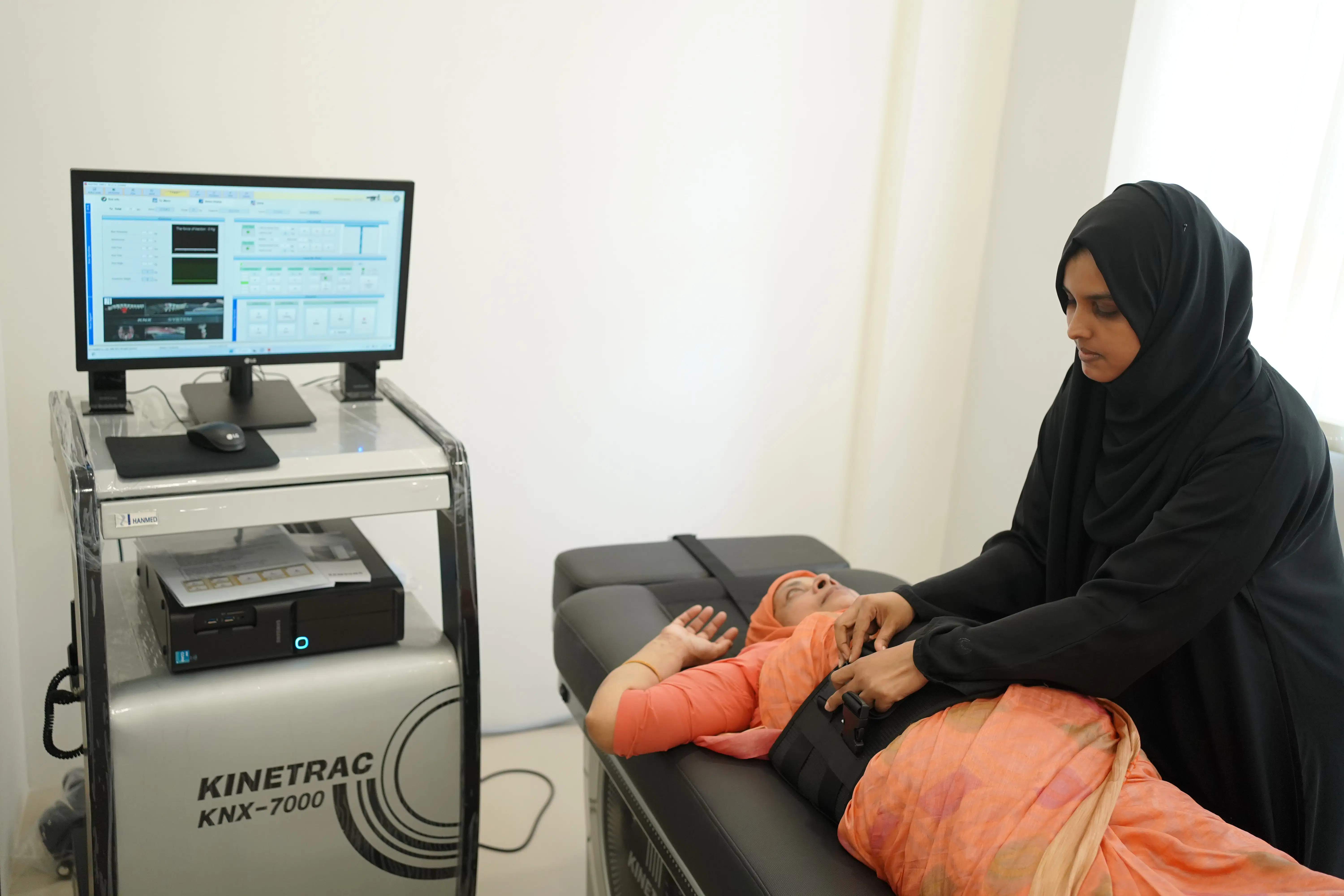
In the past, chronic back strain was often treated with manual massage or heat packs. While these feel good, they rarely change the underlying mechanics of a compressed spine. As a pioneer in Kerala, Maana Health utilizes European CE and US FDA-approved technologies that were specifically designed to treat these complex issues without the need for surgery.
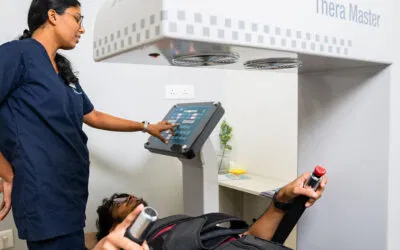
One of our primary tools for desk-related back strain is non-surgical spinal decompression. Using devices like the KNX-7000 and TheraMaster (both manufactured by experts in South Korea), we can gently distract the spine in a highly controlled, computer-monitored environment. This process creates a “negative pressure” within the disc, encouraging bulges to retract and allowing oxygen and nutrients to flow back into the injured area.
This evidence-based approach is a cornerstone of our musculoskeletal wellness programs. It targets the specific vertebrae under stress, providing a level of precision that manual therapy alone cannot achieve.
Simple stretches you can do at your Kozhikode office
To complement your ergonomic setup and any physiotherapy treatment you may be receiving, you can integrate these three simple movements into your workday:
- The Seated Glute Stretch: While sitting, place your right ankle over your left knee. Gently lean forward with a straight back until you feel a stretch in your hip. This releases the tension in the piriformis muscle, which often tightens from sitting and can mimic sciatica pain.
- The Shoulder Blade Squeeze: Imagine there is a pencil between your shoulder blades and try to pinch it. Hold for five seconds. This counters the “hunched” posture we often adopt while typing.
- The Standing Back Extension: Stand up, place your hands on your lower back, and gently lean backward. This “un-does” the forward-leaning position your spine has been in all morning.
Why choosing the right clinical partner matters
With over 10,000 patients treated, we understand that every individual’s back pain is different. A banker in Kozhikode has different physical stressors than a software engineer or a healthcare worker. Your recovery requires a personalized treatment protocol that combines ergonomic education with clinically validated technology.
When you search for physiotherapy in Kozhikode, look for a center that prioritizes a diagnostic-first approach. At Maana Health, we don’t just treat the pain you feel today; we look at your movement patterns, your workspace habits, and your spinal health to ensure you have more healthy years of life ahead.
If you are tired of your back dictating how much work you can get done or how much you can enjoy your evenings, it might be time to look beyond your desk setup.
Speak to one of our physiotherapists to understand how we can help you regain your mobility and live a life free from back strain.
Frequently Asked Questions
How does prolonged sitting affect the spine? Sitting for extended periods causes the spine to lose its natural ‘S’ curve and slump into a ‘C’ shape, putting sustained pressure on the intervertebral discs between the vertebrae.
Can sitting all day actually cause a herniated disc? Constant compression from poor sitting posture over time can contribute to conditions like a herniated disc (where the disc’s inner gel bulges out) or spinal stenosis (narrowing that compresses nerves).
What’s the first ergonomic fix for desk-related back pain? Start with your chair — feet should be flat on the floor with knees bent at roughly a 90-degree angle; if your chair is too high and feet dangle, it adds strain to the lower back.
Is expensive equipment necessary to fix a desk setup? No — practical ergonomics is mainly about alignment and small adjustments to reduce muscular load, not necessarily the most expensive furniture.