
Did you know that nearly 90% of people told they need back surgery can actually find lasting relief through non-invasive, evidence-based protocols? It is a common misconception that once a disc bulges or a nerve is pinched, the only way out is through the operating room. In reality, the human body has an incredible capacity for healing when provided with the right technological environment and clinical support.
If you are living in Perinthalmanna and find yourself dreading the stairs or reaching for painkillers just to get through a workday, you are likely looking for a way to reclaim your life without the risks of surgery. You deserve more than a quick fix that only masks the pain; you deserve a strategy that targets the root cause of your discomfort.
Why does your back still hurt after all those painkillers?
It is frustrating when you follow the standard advice: rest and medication: yet the pain keeps coming back. The reason is simple: most traditional treatments address the symptoms rather than the mechanical issue. Pain is merely your body’s alarm system. Turning off the alarm with a pill doesn’t put out the fire.
When you have a condition like sciatica: pain that radiates from the lower back through the hips and down each leg: the problem is often mechanical pressure on a nerve. Similarly, with spondylosis (age-related wear and tear of the spinal discs), the structure of your spine has changed. No amount of bed rest will physically decompress a pinched nerve or rehydrate a thinning disc. This is where specialized physiotherapy and advanced technology step in to do what medicine alone cannot.
Does a herniated disc always need surgery?
The short answer is no. A herniated disc: which happens when the soft jelly-like center of a spinal disc pushes through a tear in the tougher exterior: sounds scary. However, clinical evidence suggests that most cases respond exceptionally well to non-surgical intervention.
At Maana Spine, Joint & Wellness Clinic, Perinthalmanna, we focus on helping the disc heal itself. When a disc is herniated or bulging, it often loses its ability to absorb nutrients and fluids. By using targeted mechanical forces, we can create a “vacuum effect” that encourages the protruding disc material to pull back toward the center. This relieves the pressure on the surrounding nerves and allows the body’s natural inflammatory response to settle down without the need for an incision.
What actually happens during spinal decompression?
You might have heard the term “spinal decompression” and wondered if it is just a fancy word for traction. While they share some principles, modern spinal decompression is a far more advanced, computer-controlled process.
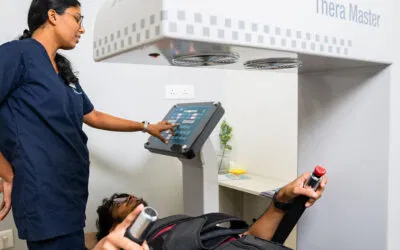

At our clinic, we use South Korean-manufactured technology like the TheraMaster (by Shinhwa Medical) and the KNX-7000 (by Hanmed). These devices are designed to overcome the body’s natural tendency to guard or tense up during stretching. If you simply pull on the spine, your muscles will contract to protect it. The KNX-7000 uses sophisticated sensors to bypass this muscle guarding.
By applying precisely measured pulling forces at specific angles, these machines create a negative pressure: typically between -150 to -200 mm Hg: within the disc. This negative pressure is the “magic” that facilitates the movement of fluids, oxygen, and nutrients back into the disc. This isn’t just a temporary stretch; it is a clinical process aimed at disc rehydration and repair.
Why is the 18-Day Intensive Spine Program the standard in Perinthalmanna?
Recovering from chronic back pain isn’t a one-off event; it’s a process. This is why we developed the 18-Day Intensive Spine Program. We realized that for patients in Perinthalmanna, Manjeri, and surrounding areas, a scattered approach to physiotherapy often leads to inconsistent results.
Our program is a structured, evidence-based journey. It combines:
- Daily Spinal Decompression: Using the KNX-7000 or TheraMaster to address the mechanical disc issues.
- Advanced Modalities: Integrating treatments like Hyperbaric Oxygen Therapy (HBOT) or Cryotherapy where necessary to reduce systemic inflammation and speed up tissue repair.
- Active Rehabilitation: Moving from passive machine-led therapy to active, supervised exercises that strengthen the “core” muscles supporting your spine.
- Ergonomic Education: Teaching you how to move, sit, and sleep so you don’t recreate the injury once you leave the clinic.
This 360-degree approach ensures we aren’t just giving you a few days of relief, but rather building a foundation for more healthy years of life.
Can advanced technology really replace a surgeon’s scalpel?
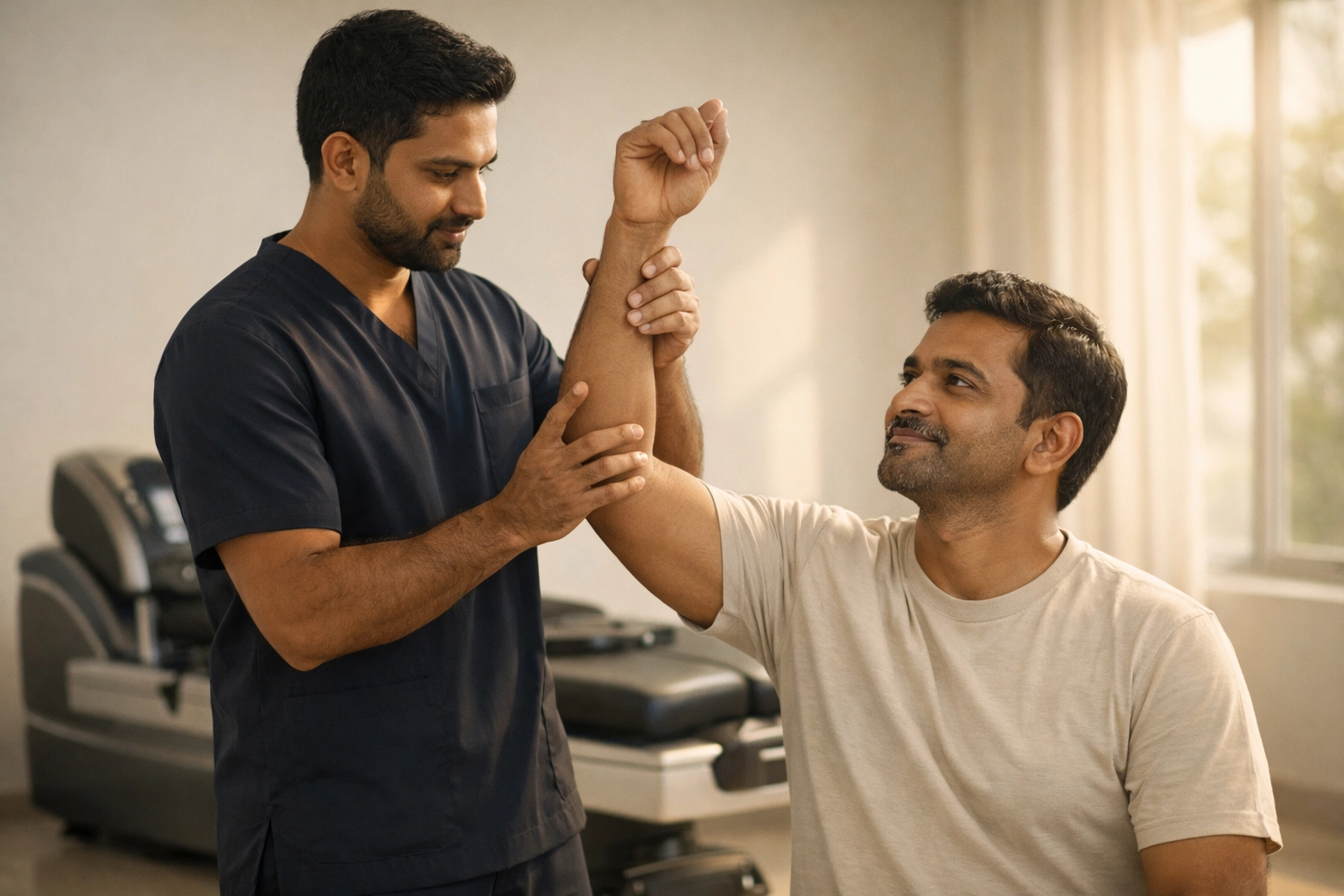
While some extreme cases (like those involving loss of bladder control or progressive muscle wasting) do require surgery, the vast majority of spinal issues can be managed with FDA and CE-approved technology.
Take spinal stenosis: a narrowing of the spinal canal that compresses the nerves. Traditionally, surgeons might perform a laminectomy to create space. However, through non-surgical decompression and targeted physiotherapy, many patients find that reducing the inflammation and improving the alignment of the vertebrae provides sufficient space for the nerves to function without pain.
We also use specialized tools for related issues. For instance, if you are experiencing calcaneal heel spurs or carpal tunnel syndrome alongside your back pain, we use clinically validated protocols to treat those areas simultaneously. Our goal is a pioneer in Kerala: providing a single destination where the most advanced non-invasive technologies converge to treat the whole musculoskeletal system.
What should you expect at a physiotherapy clinic in Perinthalmanna?
Walking into a clinic for the first time can be intimidating. At Maana Spine, Joint & Wellness Clinic, Perinthalmanna, we start with a deep dive into your history. We don’t just look at your MRI; we look at how you move, how you stand, and where your specific pain triggers are.
A typical session in our spine program is designed to be comfortable and relaxing. Many of our patients actually find the spinal decompression sessions on the KNX-7000 so soothing they nearly fall asleep. You are secured with safety belts that ensure the force is applied exactly where it is needed: whether that is the cervical spine (neck) or the lumbar spine (lower back).
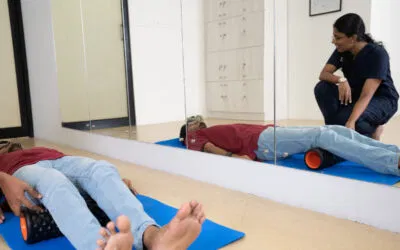
Beyond the machines, our physical therapists work with you on movement patterns. We use evidence-based exercise therapy to ensure that once we have relieved the pressure on your nerves, your muscles are strong enough to keep that pressure off for good. This focus on the root cause not just symptoms is what sets our clinic apart.
Is this treatment right for your specific condition?
Non-surgical spine treatment is highly effective for a wide range of conditions, including:
- Degenerative Disc Disease: Helping “worn out” discs regain some of their height and function.
- Facet Syndrome: Addressing pain arising from the small joints between the vertebrae.
- Bulging Discs: Using negative pressure to encourage the disc to return to its proper space.
- Chronic Back and Neck Pain: Especially when the cause is postural or work-related.
If you have been told you have “bone on bone” or that your spine is “simply aging,” do not lose hope. Most patients we see have been through the cycle of rest, heat packs, and pills without success. They find that our technology-led rehabilitation offers a path forward that they previously didn’t think was possible.
Taking the first step toward a pain-free life
Living with chronic pain is exhausting. It drains your energy, affects your mood, and limits your ability to be present for your family and your work. But you don’t have to accept it as your “new normal,” and you don’t necessarily have to face the risks and long recovery times associated with surgery.
With over 10,000 patients treated across our locations, Maana Health has seen firsthand how the right combination of clinical expertise and FDA-approved technology can transform lives. We are proud to bring this level of care to Perinthalmanna, offering a non-surgical and no side effects alternative to traditional spine care.
If you are tired of the “quick fix” and are ready to invest in a long-term solution for your spinal health, we invite you to take the next step.
Speak to one of our physiotherapists at Maana Spine, Joint & Wellness Clinic, Perinthalmanna, to see how our personalized protocols can help you get back to the activities you love.