
Authored by Ashitha Abdul Ashraf, Senior Consultant Physiotherapist – Incharge | Medically Reviewed by Dilshana Thasni T, Senior Consultant Physiotherapist | Last Reviewed: June 2026
If you have chronic back pain, sciatica, or a disc herniation that has not responded to basic physiotherapy or medication, spinal decompression therapy is probably the most important treatment option you have not tried yet.
This guide explains exactly how it works, which conditions it treats effectively, who is not a suitable candidate, and what a full course of treatment looks like.
What Is Spinal Decompression Therapy?
Spinal decompression therapy is a non-surgical treatment that uses a motorised table to apply precise, controlled traction to the spine. The goal is to reduce pressure inside compressed spinal discs and create conditions that allow damaged discs to heal.
It is not the same as old-style manual traction where a therapist pulls on your legs or a basic traction machine applies a constant pulling force. Computerised spinal decompression controls the angle, force, rhythm, and duration of each distraction cycle with precision that manual traction cannot match.
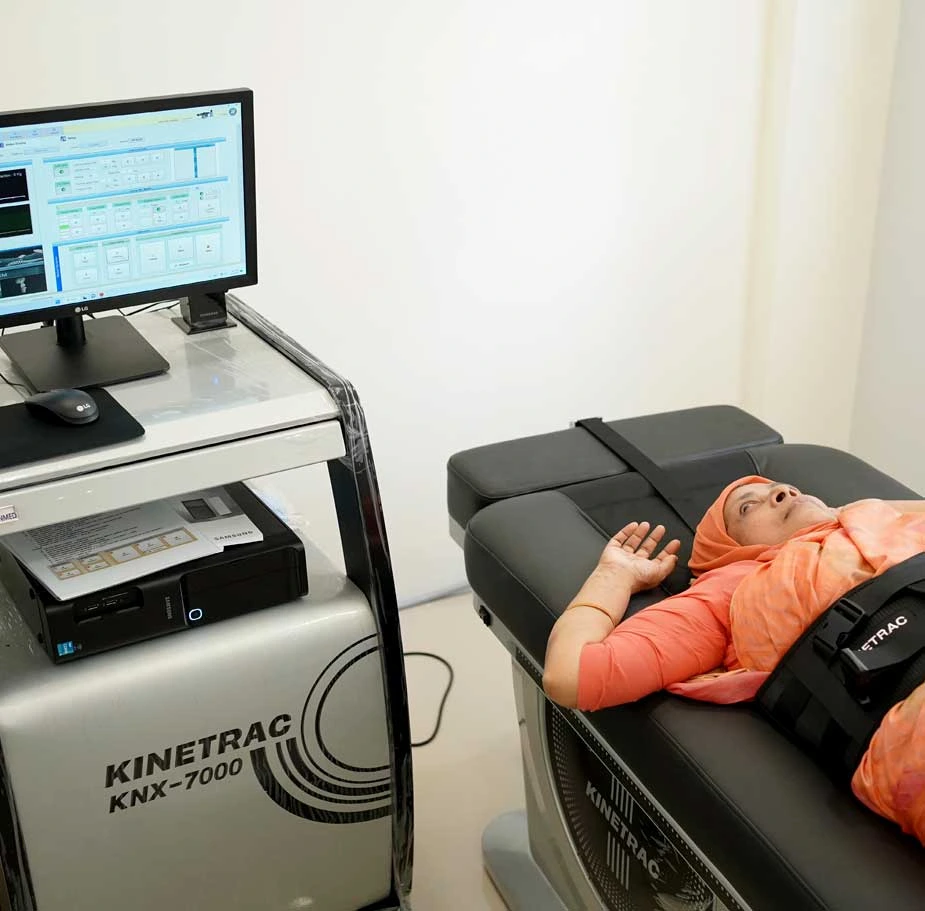
At Maana Health, spinal decompression is performed using the KNX-7000 system — an FDA and CE-approved device used in specialist rehabilitation centres across the world.
The Science Behind It
To understand why spinal decompression works, you need to understand what happens to a disc when it is compressed.
A healthy disc is well-hydrated. It receives nutrients through a process called imbibition — the disc absorbs water and nutrients from surrounding tissue during movement and load changes. When a disc is chronically compressed, this process is disrupted. The disc dehydrates, loses height, and loses its ability to absorb load. Herniated material presses on nearby nerves, causing pain, numbness, and weakness.
Spinal decompression creates negative intradiscal pressure — pressure below atmospheric level inside the disc. Two things happen as a result:
First, the negative pressure draws herniated or bulging disc material back toward the centre of the disc, away from the nerve it is pressing on. This directly reduces nerve compression.
Second, the pressure change creates a pumping effect that draws water, oxygen, and nutrients back into the dehydrated disc. This supports actual disc healing, not just symptom management.
This is why spinal decompression produces results that basic physiotherapy exercises and pain medication cannot achieve for disc conditions. Exercises and medication manage symptoms. Decompression addresses the disc itself.
Conditions Spinal Decompression Treats
Spinal decompression is specifically effective for disc-related conditions. It is not a general back pain treatment.
Lumbar disc herniation. The most common indication. The herniated disc material is pressing on a nerve root, causing lower back pain and sciatica. Decompression directly reduces this pressure.
Sciatica. Pain, numbness, or tingling that travels from the lower back down the leg — often to the calf or foot. When sciatica is caused by disc compression, decompression is one of the most effective conservative treatments available.
Degenerative disc disease. As discs lose height and hydration, the vertebrae above and below move closer together, compressing nerves and facet joints. Decompression restores disc height and hydration over a course of treatment.
Cervical disc herniation. The same principle applied to the neck. Disc problems in the cervical spine causing arm pain, numbness, or weakness respond to cervical spinal decompression.
Spinal stenosis. Narrowing of the spinal canal that compresses nerve roots. Decompression reduces pressure in cases without severe structural stenosis or significant neurological deficit.
Facet joint syndrome. Compression and irritation of the facet joints between vertebrae. Decompression reduces the compressive load on these joints.
Who Is Not a Suitable Candidate
Spinal decompression is not appropriate for everyone. A proper assessment before treatment is non-negotiable.
You are not a suitable candidate if you have:
- Severe osteoporosis with significant fracture risk
- A spinal fracture — healed or current
- Spinal implants, rods, or hardware from previous surgery
- Spinal fusion at the level being treated
- Active spinal tumour or infection
- Cauda equina syndrome — this is a surgical emergency, not a decompression indication
- Pregnancy
- Severe aortic aneurysm
Your physiotherapist will screen for all of these before recommending treatment. If you have had previous spinal surgery, disclose this fully at assessment. Previous surgery does not automatically exclude you, but it changes the treatment protocol.
What a Treatment Session Looks Like
A spinal decompression session is not uncomfortable. Most patients find it relaxing.
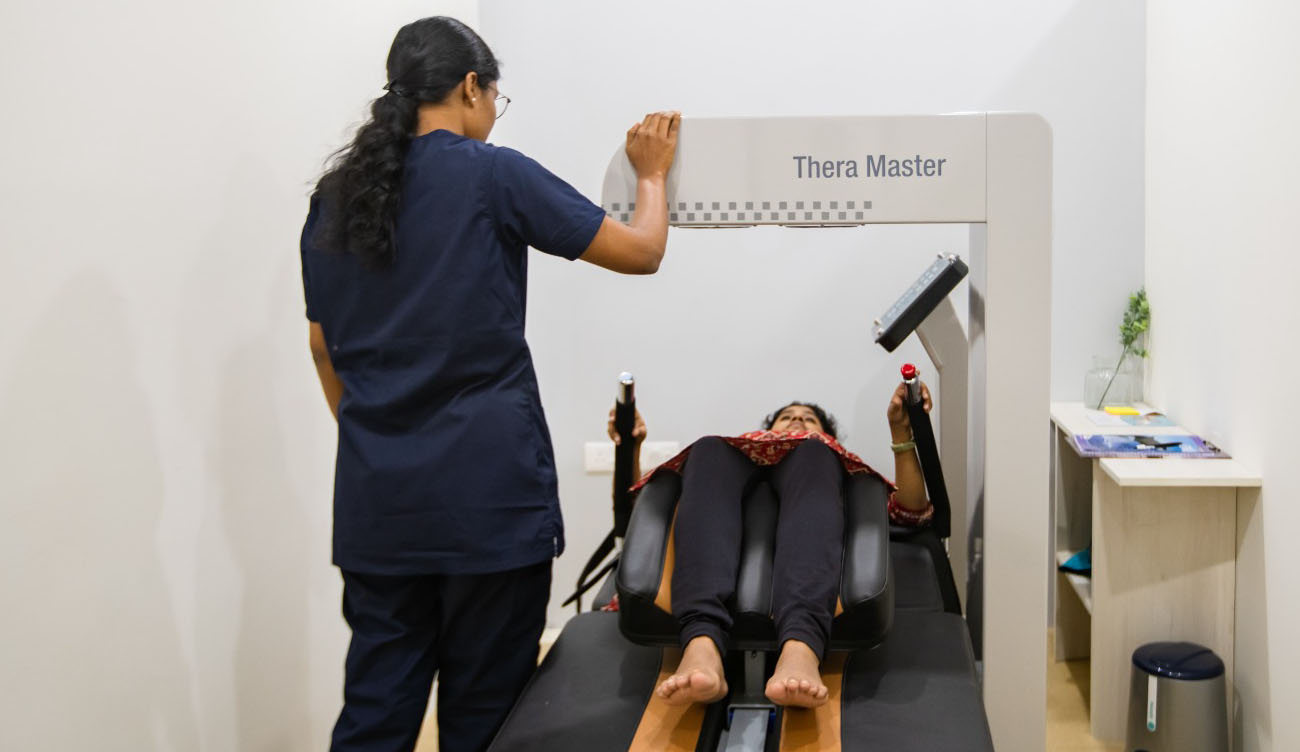
You lie on the KNX-7000 table fully clothed. A harness is fitted around your pelvis for lumbar treatment, or your head is positioned in a cervical cradle for neck treatment. The table does the work.
The machine applies a gentle pulling force, holds it for a set duration, then releases partially before pulling again. This rhythmic cycle continues for the duration of the session. The force, angle, and rhythm are set precisely for your disc level and condition.
Each session lasts approximately 30 to 45 minutes. Most patients feel a gentle stretching sensation. Some feel immediate relief of leg symptoms during the session. A small number feel mild soreness in the first day or two as the body adjusts — this is normal and settles quickly.
How Many Sessions Do You Need?
A standard course of spinal decompression for lumbar disc herniation with sciatica is 15 to 20 sessions, typically three to five sessions per week.
Most patients begin noticing improvement within the first five to eight sessions. Significant improvement in sciatica — reduction in leg pain, numbness, and tingling — is usually apparent by session 10 for suitable candidates.
Spinal decompression works best as part of a broader treatment program. Sessions are combined with targeted physiotherapy exercises that strengthen the muscles supporting the spine, reducing the load on the discs between decompression sessions. Without the exercise component, results are less durable.
Realistic Outcomes
Spinal decompression is effective for the right patients. It is not a guaranteed cure for every back pain presentation.
For lumbar disc herniations with sciatica in patients who have not had previous spinal surgery, the outcomes are consistently good in clinical practice. Patients who have had months of leg pain, tried physiotherapy, taken medication, and received injections without adequate relief frequently achieve significant improvement with a full course of decompression.
For degenerative disc disease, outcomes are good for pain and function but require realistic expectations. Degeneration is a chronic condition. Decompression manages it effectively but does not reverse structural degeneration.
For post-surgical patients, outcomes vary based on the surgery performed and the condition of the remaining disc tissue. Assessment determines suitability.
Spinal Decompression vs Surgery: The Honest Picture
For disc herniations and sciatica without progressive neurological deficit, spinal decompression is a legitimate alternative to surgery in many cases. It is lower risk, has no recovery downtime, and produces comparable outcomes to discectomy for a significant proportion of patients.
Surgery has a place. If you have progressive leg weakness, worsening neurological signs, or cauda equina involvement, surgery is appropriate and should not be delayed. If you have pain and sciatica without neurological deterioration, a full course of spinal decompression is worth completing before committing to a surgical procedure.
The question to ask your surgeon is direct: if I complete a proper 6-week course of spinal decompression and it does not produce adequate improvement, is surgery still an option? The answer is almost always yes. A trial of decompression does not close the surgical option.
Frequently Asked Questions
Is spinal decompression the same as traction?
They use a similar principle but are not the same. Manual traction applies a constant pulling force. Computerised decompression applies a rhythmic, variable distraction at a precise angle targeting a specific disc level. The control and precision are significantly greater with computerised decompression, which is why outcomes are better.
Can I have spinal decompression if I have had back surgery?
It depends on the surgery. Fusion at the treated level excludes decompression at that level. Discectomy without fusion does not automatically exclude you. Disclose your surgical history fully at assessment and your physiotherapist will determine suitability.
How quickly will I know if it is working?
Most patients notice some change within the first five to eight sessions. If there is no change at all after ten sessions, the treatment plan should be reassessed.
Is the treatment painful?
For most patients, no. The session involves a gentle pulling sensation that most people find comfortable. Some patients feel mild muscle soreness in the first day or two of treatment. Significant pain during a session should be reported immediately.
Does insurance cover spinal decompression in India?
Coverage varies. Some policies cover it under physiotherapy benefits. Check your specific policy before starting treatment. Maana Health staff can assist with insurance queries.
Can I continue working during a course of spinal decompression?
For desk-based work, yes in most cases. For heavy manual work, your physiotherapist will advise on activity modification during the treatment course.
Spinal decompression therapy using the KNX-7000 system is available at Maana Health clinics across Kerala — Kochi, Calicut, Perinthalmanna, Aluva, and Trivandrum. If you have disc-related back pain or sciatica that has not responded to basic treatment, book a free assessment to find out whether spinal decompression is right for you.