
Authored by Ashitha Abdul Ashraf, Senior Consultant Physiotherapist – Incharge | Medically Reviewed by Dilshana Thasni T, Senior Consultant Physiotherapist | Last Reviewed: June 2026
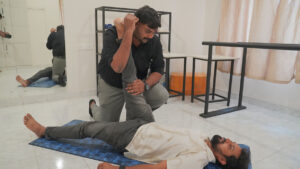
An ACL tear is one of the most feared sports injuries in Kerala. Football players, badminton players, basketball players — anyone who pivots, cuts, or lands from a jump is at risk. When it happens, the default response from most orthopaedic surgeons is reconstruction surgery followed by 9 to 12 months of rehabilitation.
But surgery is not the only option. A significant proportion of ACL-deficient patients — people who have torn their ACL and chosen not to have surgery — return to sport and maintain good knee function long-term through structured non-surgical rehabilitation.
This guide gives Kerala athletes the honest picture: who can manage without surgery, what non-surgical rehabilitation involves, and when surgery is genuinely the better choice.
What the ACL Does and What Happens When It Tears
The anterior cruciate ligament runs diagonally through the centre of the knee, connecting the femur to the tibia. Its primary function is preventing the tibia from sliding forward on the femur and controlling rotational stability of the knee.
When the ACL tears — typically during a non-contact deceleration, landing, or pivoting movement — the knee loses its primary restraint against forward tibial translation and rotation. This is felt as instability — the knee giving way during cutting movements, landing, or even walking on uneven ground.
ACL tears are graded:
Grade 1: Microscopic fibre damage. The ligament is stretched but intact. These heal with conservative management.
Grade 2: Partial tear. Some fibres are disrupted. Clinical management depends on degree of instability and functional demands.
Grade 3: Complete rupture. The ligament is fully torn and will not heal spontaneously. This is what most people mean when they say they have torn their ACL.
The Conventional View — and Why It Is Changing
For decades, the standard recommendation for a complete ACL tear in an active young person was surgical reconstruction. This remains the recommendation for many patients. But the evidence supporting universal surgical management has weakened significantly.
A landmark Scandinavian study — the KANON trial — randomised young active adults with complete ACL tears to either early surgery plus rehabilitation, or rehabilitation alone with the option of delayed surgery. At five years, outcomes were similar between the two groups for pain, function, and return to sport. Importantly, approximately 50% of the rehabilitation-only group never needed surgery.
A ten-year follow-up of the same study found no significant difference in osteoarthritis development between the surgical and non-surgical groups — challenging the long-held belief that ACL reconstruction protects against long-term joint degeneration.
This does not mean surgery is wrong. It means it is not automatically necessary for every patient.
Who Can Manage Without Surgery
Not everyone with an ACL tear is a suitable candidate for non-surgical management. These are the factors that predict who does well without reconstruction.
Copers vs Non-Copers
Research has identified two broad groups among ACL-deficient patients.
Copers are patients who, after appropriate rehabilitation, can perform sport-specific activities without knee instability. Their neuromuscular system compensates for the absent ACL through muscle activation patterns — particularly of the hamstrings and quadriceps — that stabilise the knee dynamically.
Non-copers are patients whose knee remains unstable despite rehabilitation. They give way during daily activities, exercise, or sport. For non-copers, surgery is the appropriate management.
The critical point is that coper vs non-coper status cannot always be predicted at the time of injury. It is determined through a structured rehabilitation program and functional testing. This is why most sports medicine specialists now recommend a trial of rehabilitation before making the surgical decision for appropriate patients — not the other way around.
Factors Favouring Non-Surgical Management
- Lower sport demand level — recreational rather than competitive athlete
- Sports that do not involve pivoting, cutting, or contact — swimming, cycling, running in a straight line
- Older age — the risk-benefit calculation of surgery changes with age
- Isolated ACL tear without significant associated meniscus or cartilage damage
- Strong quadriceps and hamstring baseline strength
- Willingness to potentially modify sport participation
Factors Favouring Surgery
- High-level competitive athlete in a pivoting sport — football, basketball, badminton, kabaddi
- Age under 25 with many years of sport ahead
- Associated meniscus tear requiring repair — meniscus repair heals better in the biological environment created by ACL reconstruction
- Significant instability that persists after rehabilitation
- Multiple ligament injury
What Non-Surgical ACL Rehabilitation Involves
Non-surgical management is not passive. It is not rest followed by return to sport. It is an intensive, structured program that typically runs 9 to 12 months — the same timeline as surgical reconstruction rehabilitation.
Phase 1: Acute Management (Weeks 1 to 3)
The immediate priority after ACL injury is managing swelling, restoring range of motion, and preventing muscle atrophy.
- RICE protocol for the first 48 to 72 hours
- Early weight bearing as tolerated with crutches if needed
- Knee extension exercises — achieving full passive knee extension in the first week is critical
- Quadriceps activation — the quad shuts down rapidly after knee injury due to pain and swelling. Restoring quad activation is the priority of this phase.
- Stationary cycling when swelling allows — typically within the first week for most patients
Phase 2: Strength Foundation (Weeks 3 to 8)
Building the muscular foundation that will compensate for the absent ACL.
- Closed chain strengthening — squats, leg press, step-ups, lunges
- Hamstring strengthening — the hamstrings are the primary dynamic stabiliser for the ACL-deficient knee. Hamstring strength in this situation cannot be over-emphasised.
- Hip strengthening — gluteus medius and maximus weakness is consistently found in ACL-deficient patients and contributes to instability. Hip strengthening is a required component, not optional.
- Balance and proprioception training — beginning with double-leg balance and progressing to single-leg challenges
Phase 3: Neuromuscular Control (Weeks 8 to 16)
This phase develops the neuromuscular patterns that allow the ACL-deficient knee to function stably during dynamic movements.
- Single-leg strengthening — single leg squat, single leg deadlift, step-down exercises
- Progressive balance and perturbation training
- Lateral movement and change of direction — beginning with slow, controlled movements
- Light jogging on flat surfaces when strength criteria are met
Phase 4: Sport-Specific Training (Months 4 to 9)
Progressive loading toward sport demands.
- Running program with progressive speed and direction changes
- Agility drills — ladder drills, cone work, deceleration training
- Sport-specific movement patterns at increasing speed and load
- Plyometric training — jumping and landing mechanics
Phase 5: Return to Sport Testing (Month 9 to 12)
Return to full sport is based on objective criteria, not time alone.
- Quadriceps strength symmetry — injured side within 90% of uninjured side
- Hamstring strength symmetry — within 90% of uninjured side
- Single leg hop tests — four standardised hop tests with symmetry index above 90%
- Psychological readiness — formal assessment of confidence in the knee
- Sport-specific movement quality assessment
Athletes who do not meet these criteria should not return to pivoting sport regardless of how they feel subjectively. Re-injury risk is directly correlated with failure to meet objective return to sport criteria.
The Role of Bracing in Non-Surgical ACL Management
Functional ACL braces provide external restraint against anterior tibial translation and rotation. They are commonly prescribed for ACL-deficient patients returning to sport.
The evidence on whether bracing actually prevents re-injury is mixed. Braces do not replace neuromuscular rehabilitation — they should be used as an adjunct to a complete strengthening program, not instead of one.
For ACL-deficient patients returning to pivoting sport, a functional brace fitted by a specialist provides some additional protection during the transition back to full sport participation. The physiotherapist and orthopaedic surgeon can advise on appropriate brace selection.
Monitoring for Giving Way Episodes
The critical outcome metric for non-surgical ACL management is giving way episodes — moments where the knee buckles, pivots, or feels unstable during activity.
Giving way episodes cause repeated meniscus damage and cartilage injury. Multiple giving way episodes in an ACL-deficient knee accelerate joint degeneration and are the primary argument for surgical reconstruction in patients who are otherwise managing.
If you choose non-surgical management and experience giving way during rehabilitation or after return to sport, surgical consultation is appropriate. Delaying reconstruction after repeated giving way episodes increases the risk of irreparable meniscus and cartilage damage.
Delayed Surgery: Keeping the Option Open
Choosing non-surgical management does not permanently close the surgical option. A patient who completes rehabilitation and remains stable has made a good decision. A patient who completes rehabilitation but experiences instability or giving way can proceed to surgical reconstruction at that point.
The question your surgeon should be able to answer honestly is: if I complete a full rehabilitation program and my knee remains unstable, can we still reconstruct the ACL at that point? For most patients, the answer is yes. Delayed reconstruction after a rehabilitation trial is a well-established pathway.
Frequently Asked Questions
Can the ACL heal on its own?
A complete ACL tear does not heal spontaneously. The ACL has poor intrinsic healing capacity due to its location within the joint and its blood supply characteristics. What non-surgical management achieves is not ACL healing but neuromuscular compensation for the absent ligament.
Will I develop arthritis faster without surgery?
The KANON trial and its long-term follow-up do not support the assumption that surgery protects against osteoarthritis better than rehabilitation alone. The primary drivers of post-ACL arthritis are meniscus damage and cartilage injury — which can occur with or without surgery and are more closely related to giving way episodes than to the reconstruction itself.
Can I return to football without surgery?
Some patients do — particularly those who test as copers and whose football involvement is recreational rather than competitive. For competitive footballers who play at a high level involving frequent contact, cutting, and pivoting, surgical reconstruction is generally the recommended pathway. This is a decision made with a sports medicine doctor or orthopaedic surgeon based on your specific level of play and functional testing outcomes.
How do I know if I am a coper?
Coper status is determined through a rehabilitation program and functional testing — not a scan or a clinical examination at the time of injury. If your physiotherapist conducts a structured 12 to 16 week rehabilitation program and your knee tests stable on hop and strength testing, you are likely a functional coper. If instability persists, you are not.
Is non-surgical ACL management available in Kerala?
Yes. A structured non-surgical ACL rehabilitation program requires an experienced sports physiotherapist, appropriate equipment for progressive loading, and formal return to sport testing. This is available at Maana Health across our five Kerala clinics.
Maana Health provides ACL rehabilitation — both non-surgical and post-surgical — across five clinics in Kerala — Kochi, Calicut, Perinthalmanna, Aluva, and Trivandrum. If you have had an ACL injury and want to understand all your options before making a treatment decision, book a free assessment with our senior physiotherapists.